Dissolving the Doctrine of Divorce

In this blog, I\’m going to explore the typical church doctrine of divorce and the Biblical view of divorce, showing what we\’ve been taught to believe and what the scriptures actually teach, are incompatible.

The Principle of First Mention

The Principle or Law of First Mention (see here) simply means this: when someone is first exposed to an idea, that exposure will color or influence every exposure to the same information thereafter. This principle is why most parents want to teach their children about sex before anyone else: they want to set a proper context and framework from which the subject will be understood henceforth. We can see this principle in the extreme when a child is sexually abused: the abuse colors their self-worth and understanding of intimacy for the rest of their lives.
In Scripture, the principle functions much the same way – although it must be handled carefully. In example, you can\’t look to Cain\’s offering and assume the Grain Offering (more here) that was instituted later, is unacceptable.
The Mosaic Law mentions divorce, and it specifically addresses key issues that must be considered as Jesus deals with the topic when questioned by the religious leaders of the time.  In this way divorce, as found in the Law, must be considered as \”first mention\” material.

The Fundamentalist\’s Viewpoint of Divorce

It is practically impossible to parse any Christian doctrine of divorce, listen to a sermon about divorce, or discuss divorce with a Fundamentalist without having at least these scriptures used as proof texts as to why divorce is sin and no one should ever get a divorce:

It hath been said, whosoever shall put away his wife, let him give her a writing of divorcement: But I say unto you, That whosoever shall put away his wife, saving for the cause of fornication, causeth her to commit adultery: and whosoever shall marry her that is divorced committeth adultery. (Matthew 5:31-32)

For the LORD, the God of Israel, saith that he hateth putting away: for one covereth violence with his garment, saith the LORD of hosts: therefore take heed to your spirit, that ye deal not treacherously. (Malachi 2:16)

The problem I\’ve encountered (and have in the past been guilty of myself) is that while discussing some doctrines with some people, one will find they may not rely upon well-reasoned or well-formed exegesis to arrive at their conclusions. They instead point to consensus: how many Pastors teach the same thing, or how their denominational sect has maintained the doctrine for a very long time.  In the process, they cherry-pick their scriptures carefully to support their doctrine, or perhaps they may take a page from a certain Southern Baptist Preacher who first said in the mid-1980\’s, \”God said, I believe it, that settles it,\” – without any real reasonable scriptural foundation.

I would like to suggest that good doctrine is reasonable:
But the wisdom from above is first pure, then peaceable, gentle, reasonable, full of mercy and good fruits, unwavering, without hypocrisy. (James 3:17)

The astute student will note that wisdom is different from knowledge: wisdom addresses how to do something whereas knowledge addresses what something is.  Thus wisdom, in view of the doctrine of divorce, is correct in this instance since the doctrine address how to do (or not do) divorce.

But suffice it to say, the Fundamentalist\’s viewpoint on divorce is simply this:
  1. God hates divorce (Malachi 2:16)
  2. Jesus said one commits adultery by remarrying after divorce (Matthew 5:31-32)

Does God Really Hate Divorce?

If divorce is a sin, then yes: God hates divorce.  But first, let\’s understand hate. 
From a Biblical point of view, hate is not criticism, mean words, or an intense dislike, as it is typically defined throughout the blogosphere and various pulpits of today.   Hate is the opposite of love; it is not apathy as many have been taught.

Love is an action word and apathy is inaction, therefore, apathy cannot be the opposite of love.  Love builds up, it is constructive.  Hate tears down, it is destructive.  Therefore, hate is the opposite of love.  What Jesus did on the cross was hate poured out upon death:

But is now made manifest by the appearing of our Saviour Jesus Christ, who hath abolished death, and hath brought life and immortality to light through the gospel: (2 Timothy 1:10)
The word abolished means to \”render entirely idle\”.  What Jesus did in the flesh was the manifest action of hatred towards sin and death.  So then, if God hates divorce, then He wants to abolish it.  That is actually a reasonable position, in my opinion.

Is divorce Sin?  

I will provide you the following scripture and let you be the judge:

And I saw that for all the adulteries of faithless Israel, I had sent her away and given her a writ of divorce, yet her treacherous sister Judah did not fear; but she went and was a harlot also (NASB). (Jeremiah 3:8)

Thus saith the LORD, Where is the bill of your mother\’s divorcement, whom I have put away? (KJV) (Isaiah 50:1)

In other words, God is divorced – and He initiated the divorce Himself.  I would also like to suggest that God in the process of reconciliation, but that is a topic for another time.

However, for our Fundamentalist friends, that bit of scripture should put them in a treacherous quandary, should they accept the Bible as written: for when one teaches that divorce is a sin, then one has the unfortunate and untenable position of defending such a theology in the light of Jeremiah 3:8.

Divorce vs. Sent Away

Notice also the two activities associated with divorce: He \”put her away,\” and secondly, He gave \”her a writ of divorce.\”  Those activities, while related, are not one in the same.  In other words, we can send someone away without being divorced (inside or outside of marriage), but we can\’t be divorced without sending someone away.  Thus, sending away can be likened to sending someone on an errand or being estranged prior to divorce, while being divorced consists of a decree and a separation.

The Hebrew word for divorce is kerı̂ythûth (Strong\’s H3748): a cutting (of the matrimonial bond), that is, divorce: – divorce (-ment).

It is used 4 times:

  • Deuteronomy 24:1 – \”then let him write her a bill of divorcement (kerı̂ythûth)\”
  • Deuteronomy 24:3 – \”write her a bill of divorcement (kerı̂ythûth)\”
  • Isaiah 50:1 – \”Where is the bill of your mother\’s divorcement (kerı̂ythûth)\”
  • Jeremiah 3:8 – \”I had put her away, and given her a bill of divorce (kerı̂ythûth)\”
Now let\’s look at Malachi 2:16, and the word for \”putting away\”the proof text used by many to prove that God hates divorce).  The Hebrew word for putting away is shâlach (Strongs\’s H7971).  It is used 848 times in the KJB in 791 verses.

A primitive root; to send away, for, or out (in a great variety of applications): – X any wise, appoint, bring (on the way), cast (away, out), conduct, X earnestly, forsake, give (up), grow long, lay, leave, let depart (down, go, loose), push away, put (away, forth, in, out), reach forth, send (away, forth, out), set, shoot (forth, out), sow, spread, stretch forth (out).

In the scriptures used with divorce, we see it used as follows:
  • Deuteronomy 24:1 – \”give it in her hand, and send (shâlach) her out of his house\”
  • Deuteronomy 24:3 – \”giveth it in her hand, and sendeth  (shâlach) her out of his house\”
  • Isaiah 50:1 – \”whom I have put away  (shâlach)\”
  • Jeremiah 3:8 – \”I had put her away (shâlach)\”

Otherwise, it is translated in various other forms:
And the LORD God said, Behold, the man is become as one of us, to know good and evil: and now, lest he put forth his hand, and take also of the tree of life, and eat, and live for ever: (Genesis 3:22)
And he sent forth a raven, which went forth to and fro, until the waters were dried up from off the earth. (Genesis 8:7)
When Esau saw that Isaac had blessed Jacob, and sent him away to Padanaram, to take him a wife from thence; and that as he blessed him he gave him a charge, saying, Thou shalt not take a wife of the daughters of Canaan; (Genesis 28:6)
And I will send fire upon Magog and those who inhabit the coastlands in safety; and they will know that I am the Lord. (Ezekiel 39:6)
Neither shall they shave their heads, nor suffer their locks to grow long; they shall only poll their heads. (Ezekiel 44:20)
For the LORD, the God of Israel, saith that he hateth putting away: for one covereth violence with his garment, saith the LORD of hosts: therefore take heed to your spirit, that ye deal not treacherously. (Malachi 2:16)
In regards to a permanent separation (a cutting away, divorce), then we clearly understand that shâlach in Genesis 3:22 doesn\’t imply their hands would be separated from them, shâlach  in Genesis 8:7 doesn\’t suggest the raven never came back, and shâlach in Genesis 28:6 does not imply that Jacob never returned.

While it is clear that interpretation is a necessary function of translation, we cannot ignore that an alternative reading of Malachi 2:16 could be \”For the LORD, the God of Israel, saith that he hateth growing long …\”  Albeit, that rendering is improper: it ignores the the context; but I provide it as a hyperbole, to help demonstrate the difference between \”putting away\” and \”divorce\” in the Old Testament.

Putting Away isn\’t Used for Divorce

I would like to suggest that in examining how shâlach is used elsewhere in the OT, we clearly find no support for it being inferred or translated as divorce.  When the OT wants to talk about divorce, it uses a very specific word for that idea.  When the OT wants to talk about a separation, it uses an entirely different word for that idea which has no inference with divorce, except when used tangentially in that context.  The closest example we find is Isaiah 50:1 when it is used to refer back to the original divorce:

Thus saith the LORD, Where is the bill of your mother\’s divorcement, whom I have put away? or which of my creditors is it to whom I have sold you? Behold, for your iniquities have ye sold yourselves, and for your transgressions is your mother put away.

Furthermore, in no circumstance would anyone understand the other examples of shâlach to mean divorce between a married couple.  But that is exactly what the Fundamentalist wants you to believe in regards to Malachi 2:16.  The question we must ask them is why: why do they want you to believe that put away means divorce in Malachi 2:16?

Perhaps the Teaching of Jesus

In Matthew 5:31-32, and in the companion verses in Mark 10, we see two words or ideas reflecting the OT idea of divorce and put away.

It hath been said, whosoever shall put away his wife, let him give her a writing of divorcement: But I say unto you, That whosoever shall put away his wife, saving for the cause of fornication, causeth her to commit adultery: and whosoever shall marry her that is divorce committeth adultery. (Matthew 5:31-32)

The Greek word for put away is apoluó (Strongs\’ G630).  It is used 69 times in 63 verses in the KJB NT, but it\’s translated as divorce only once in Matthew 5:32 (shown above).  It is translated as released, depart and even as forgiven:

G630: ap-ol-oo\’-o (apoluó) – From G575 and G3089; to free fully, that is, (literally) relieve, release, dismiss (reflexively depart), or (figuratively) let die, pardon, or (specifically) divorce: – (let) depart, dismiss, divorce, forgive, let go, loose, put (send) away, release, set at liberty.

The word indicates a separation between one thing and another, even as far to liberate one from a thing (as from a bond).  So divorce can clearly be within the implied scope of its meaning (Thayer\’s Greek Dictionary: G630).  But is that the primary usage of the word?  Perhaps not.

The Putting Away of Mary

In Matthew 1:18-19, we find Joseph and Mary are engaged, Mary is pregnant with Jesus and Joseph is planning to end the engagement.

Now the birth of Jesus Christ was on this wise: When as his mother Mary was espoused to Joseph, before they came together, she was found with child of the Holy Ghost.  Then Joseph her husband, being a just man, and not willing to make her a publick example, was minded to put her away (apoluó) privily.

The Greek word for \”espoused\” is mnēsteúō. It means to court or woo one over for the purpose of being married, to give a souvenir (engagement present), that is, betroth.  In other words, Mary was not married to Joseph when she was found to be pregnant with Jesus.

The word for \”put her away\” is apoluó.  If we are to assume that apoluó always means divorce, as some do teach, then we must by necessity re-write the doctrine of the virgin birth.

There\’s a Word for Divorce in the NT Too

The Greek word for divorce is apostasion (Strong\’s G647).  It\’s used only 3 times across 3 verses in the NT, all being translated into a form of the word divorce. 

G647: ap-os-tas\’-ee-on (apostasion) – Neuter of a (presumed) adjective from a derivative of G868; properly something separative, that is, (specifically) divorce:- (writing of) divorcement.

  • Matthew 5:31 – \”It hath been said, Whosoever shall put away his wife, let him give her a writing of divorcement\”
  • Matthew 19:7 – \”They say unto him, Why did Moses then command to give a writing of divorcement, and to put her away?\”
  • Mark 10:4 – \”And they said, Moses suffered to write a bill of divorcement, and to put her away.\”
In all of the examples provided by Scripture (both OT and NT) regarding divorce, we find two words, and two ideas: one for put away and one for divorce. It is incongruent to suggest that put way should always be translated as divorce when Holy Spirit made a specific distinction between the two words in the original text.

In other words, scripture doesn\’t say, \”whosoever shall divorce his wife, let him give her a writing of putting away.\”  But that is exactly what the Fundamentalists are suggesting you believe.  Contrary to that doctrine, we find that a lawful divorce must be executed with a written decree and a separation: it\’s not just a separation, neither is just a decree.  To suggest it\’s only a separation is to twist its usage into something not supported by scripture.  And as we will see later, the implementation of divorce was exactly the problem being corrected.

What\’s Being Hidden

But what Pastor/Teachers don\’t disclose to you, in their eloquent sermons regarding divorce – either through ignorance or purposeful obfuscation – is this: Matthew 19:7, 5:31-32 and Mark 10:4 all describe the same two distinct actions that God performed in Jeremiah 3:8 and Isaiah 50:1 –  put away and divorce.
  • Jeremiah 3:8 – \”And I {God} saw that for all the adulteries of faithless Israel, I had sent her away and given her a writ of divorce, yet her treacherous sister Judah did not fear; but she went and was a harlot also.\” 
  • Isaiah 50:1 – \”Thus saith the Lord, Where is the bill of your mother\’s divorcement, whom I have put away?\”
  • Matthew 5:31 – \”It hath been said, whosoever shall put away his wife, let him give her a writing of divorcement\” 
  • Matthew 19:7 – \”They say unto him, Why did Moses then command to give a writing of divorcement, and to put her away?\” 
  • Mark 10:4 – \”And they said, Moses suffered to write a bill of divorcement, and to put her away.\”

Furthermore, they don\’t show you is this: in Matthew 5:31-32, divorce was substituted for put away by the translators at a very key place within the message.  Reverting divorce back to the original put away changes the message completely.

The Better View of Matthew 5:31-32

In Matthew 5:31-32, we find the Greek word for divorce (apostasion) only once.  To help you understand what the translators have done, I have added the Greek words where they appear, and reverted the final translation divorce, back to put away apoluó. 

Original:

It hath been said, whosoever shall put away (apoluó) his wife, let him give her a writing of divorcement (apostasion): But I say unto you, That whosoever shall put away (apoluó) his wife, saving for the cause of fornication, causeth her to commit adultery: and whosoever shall marry her that is divorced (apoluó) committeth adultery.

Corrected:

It hath been said, whosoever shall put away (apoluó) his wife, let him give her a writing of divorcement (apostasion): But I say unto you, That whosoever shall put away (apoluó) his wife, saving for the cause of fornication, causeth her to commit adultery: and whosoever shall marry her that is put away (apoluó) committeth adultery.

The character of the scripture is entirely changed to provide a sense that someone can be put away  (estranged) without a divorce, and in that instance, marriage to a woman who has been put away causes her and the new husband to commit adultery.  Why?  Because she is not divorced.

What is being addressed are the needs of the woman who has little or no standing as an estranged, non-divorced woman.

The Two Step Divorce Process

When we accept that the scriptures reflect what everyone knows about divorce, that there are two actions – the decree and the separation – then the conversations between the Jews and Jesus come into better clarity. 
In Matthew 19, we find a conversation between the Pharisees and Jesus regarding divorce.  In this testing of Jesus, the Pharisees refer to the two-step process of divorce: give a writing of divorcement and to put her away.  The words of Jesus in red:

The Pharisees also came unto him, tempting him, and saying unto him, Is it lawful for a man to put away (apoluóhis wife for every cause?  he answered and said unto them, Have ye not read, that he which made them at the beginning made them male and female, and said, for this cause shall a man leave father and mother, and shall cleave to his wife: and they twain shall be one flesh?  Wherefore they are no more twain, but one flesh. What therefore God hath joined together, let not man put asunder.  They say unto him, why did Moses then command to give a writing of divorcement (apostasion), and to put her away (apoluó)?  He saith unto them, Moses because of the hardness of your hearts suffered you to put away (apoluó) your wives: but from the beginning it was not so.  And I say unto you, Whosoever shall put away (apoluóhis wife, except it be for fornication, and shall marry another, committeth adultery: and whoso marrieth her which is put away (apoluódoth commit adultery. (Matthew 19:3-9)

While this may seem axiomatic – there\’s a divorce decree and a separation – it\’s possible to have a separation without a divorce.  In today\’s vernacular, we call it estrangement. The estranged person is a one who is not divorced but is living on their own, separated from their spouse. I knew a woman like this when I was a young man. Her husband was living with another woman, while the estranged wife had a home elsewhere.

Nevertheless, some might say that Matthew 19 does seem to make the case for putting away being tantamount to divorcing a wife.  The same might be said about Isaiah 50:1 (Behold, for your iniquities have ye sold yourselves, and for your transgressions is your mother put away), but that argument is much more difficult since the context is unequivocally divorce.  Event though the context is the same in Matthew 19, there might be those would argue putting away as equal to divorcement.  However, there are two problems: the Law of Moses, and the pesky bit about tempting Jesus.

Tempting Jesus

The Pharisees also came unto him, tempting him, and saying unto him, Is it lawful for a man to put away his wife for every cause?  

The phrase tempting him is described by Thayer\’s Greek dictionary as follows:

in a bad sense: to test one maliciously, craftily to put to the proof his feelings or judgment, Matthew 16:1Matthew 19:3Matthew 22:18, 35Mark 8:11Mark 10:2Mark 12:15Luke 11:16Luke 20:23 (Thayer\’s Greek Lexicon: 3985)

In other words, the Pharisees were putting Jesus\’ view of the Law regarding divorce to the test.  They were using, in the context of a lawful divorcement, the word for estrangement but casting it into the culturally accepted context of divorce.  In other words, putting away a wife – the state of estrangement – was a culturally accepted form of divorce for Hebrews of Deuteronomy and the Israelites of Isaiah and Jeremiah.  This is why they were trying to entrap Him with the Law of Moses: that\’s what to test one maliciously means in this context.  

Setting Aside the Law

Hebrews 10:28 tells us, \”anyone who has set aside (atheteō) the Law of Moses dies without mercy on the testimony of two or three witnesses.\”

The word for \”set aside\” is Strong\’s G114; it means \”\’to act toward anything as though it were annulled\’; hence, to deprive a law of force by opinions or acts opposed to it, to transgress itMark 7:9Hebrews 10:28 (Ezekiel 22:26)\” (Thayer\’s Greek Lexicon: 114).

If Jesus had taught anything different than what the Law commanded regarding divorce – having annulled it – then the Scribes, Pharisees, and Sadducees would have been able to catch Him at His words (Mark 12:13-34): they would have had reason to charge Jesus with a crime.  Since they needed \”two or three witnesses,\” then we also understand why a group of Pharisees came to Him, rather than just one.

This is an important consideration for us as Christians.  The entirety of the life and ministry of Jesus rests upon Him being the spotless, sinless Lamb of God.  In other words, to contradict the Law – to annul it, to teach or do something other than what the Law instructed – was considered as sin and certainly would have been used against Him at His trial.  Hence, this is why they were trying to trap Him: to find some cause to have him arrested and killed (Matthew 12:14, 26:4).

Lack of Evidence at His Trial

But eventually, they had their fill reasoning with Him regarding the law, so much that \”no one would venture to ask Him any more questions.\”  It is also safe to assume that at His trial, the Chief Priests and Council would have recalled that Jesus said, \”till heaven and earth pass, one jot or one tittle shall in no wise pass from the law, till all be fulfilled\” (Matthew 5:18).  Certainly, they knew that \”whosoever shall keep the whole law, and yet offend in one point, he is guilty of all\” (James 2:10).

This is why they did their best to procure false witnesses against Him in order to levy charges against Him.  It was only when Jesus confessed to being the Son of God did they find an excuse to accuse Him of blasphemy (Matthew 26:63-66).

Therefore, it is axiomatic that Jesus\’ doctrine regarding divorce is in perfect alignment with the Law of Moses based both upon what He said (not \”one jot or tittle shall … pass\”) and the fact that the Council were required to manufacture false accusations against Him, and finally, at one point in His ministry, they ceased bringing arguments to Him at all.

What Saith the Law

So then, in summary we have the OT using divorce but a few times, the NT using divorce but a few times, and finally, the NT using put away seemingly as a synonym for divorce in at least one case when the religious leaders were trying to trap Him in a logical quandary against the Law.

But the real question is what does the Law say regarding divorce, the Law that Jesus fulfilled in word and deed?  Because if the Mosaic Law says anything contrary to what we are told to believe regarding what Jesus taught about divorce, then Jesus would have at least offended at one point and consequently been guilty of all.  If on the other hand, the Law of Moses does indeed contradict the Fundamentalist\’s doctrine of divorce, then perhaps their doctrine is more suited as the traditions of men, rather than truth. As Jesus said,

But in vain they do worship me, teaching for doctrines the commandments of men. (Matthew 15:9

Essentially the Law of Moses teaches the following regarding divorce and re-marriage:
When a man hath taken a wife, and married her, and it come to pass that she find no favour in his eyes, because he hath found some uncleanness in her: then let him write her a bill of divorcement, and give it in her hand, and send her out of his house.  And when she is departed out of his house, she may go and be another man\’s wife.  (Deuteronomy 24:1-3)
  1. Write a bill of divorce
  2. Put it in her hand
  3. Send her out
  4. Then she may re-marry
Since putting away (sending out) is not writing a bill of divorce, then we cannot infer putting away to be on equal standing with a divorce.  In other words, the process of writing a decree and then physically separating is the way divorce actually works – both scripturally and in our courts.  

Jesus Didn\’t Set Aside the Law

If Jesus had taught that putting away a wife (without the written decree) was the same as writing a bill of divorce (as suggested by the translators in Matthew 5:31-32), and remarriage after a divorce caused adultery, then Jesus would have \”set aside\” this very point in the Law of Moses: 

And when she is departed out of his house, she may go and be another man\’s wife.
In other words, writing a bill of divorce and giving it to her must occur before sending her out, after which time she may remarry – alas, without committing adultery – otherwise, the Mosaic Law regarding divorce contradicts both the Ten Commandments and Leviticus 20:10:

And the man that committeth adultery with another man\’s wife, even he that committeth adultery with his neighbour\’s wife, the adulterer and the adulteress shall surely be put to death.

Failing to Catch Him at His Words

But \”to catch him in His words\” was a goal of the Pharisees.  However, Scripture is clear that in failing to do any such thing, they eventually left Him alone.  So, either the Pharisees didn\’t notice that Jesus was contradicting the Law when reasoning with Him about divorce, or they understood that according to the Law of Moses, putting away a wife (estrangement) was different from legally divorcing a wife.

Or perhaps they were expecting Him to lift the scripture, \”when she is departed out of his house, she may go and be another man\’s wife,\” out of context.  I believe this is exactly how and where they were trying to trap him: they knew that a divorce executed as a written document, placed in her hand, followed by putting her out of the house.  But if they could confuse Him on this point, then they would have trapped Him in setting aside the Law.

Understanding that the exchange in Mark was for the express purpose of tricking Jesus into stumbling regarding the Law, and knowing that the same structure is used in Isaiah 50:1, then it is reasonable to see Jesus using their language (put away) while discussing their cultural interpretation of divorce.

Did Putting Away Ever Happen?

So then, the final question to resolve is this: did Jewish men put away their wives without divorcing them, and if they did, why? There are at least two sources we can draw upon to answer this question.

The first is Micha 2:9

The women of my people have ye cast out from their pleasant houses; from their children have ye taken away my glory for ever.

The word for \”women\” is \”neshei\” it occurs 10 times in the OT, and in each instance, except this one, it is translated as wives.  This verse seems to indicate that not only were the wives being evicted from their home, their husbands retained the children.

According to Robert Waters, this eviction, or putting away, was exactly the problem:

The wife that was put out of the house may well have been innocent of any wrongdoing, yet she could not marry another without a certificate of divorcement that proved her marriage was legally dissolved.  Thus, husbands who refused to give a bill of divorcement to those whom they had put away were disobeying God.  It is interesting that the same evil practice among the Jews is still going on to this day.


During the Mosaic age, a husband would often send (put) his wife away (Heb. shalach, Gk. apoluo) without a certificate of divorce. In God\’s sight, though, the husband committed adultery against her. Furthermore, his wife would find herself homeless and destitute and unable to remarry; to do so would be to commit adultery, and any man who married her would commit adultery (see Mark 10:11; Matt. 5:31-32), a crime that was punishable by death (Lev. 20:10). 


However, God laid down a procedure to prevent such evils and protect wives from such treachery. This procedure consisted of three actions: writing her a bill of divorcement, placing it in her hand, and sending her away (Deut 24:1-2).

But what was the advantage to the man, why would he put a woman on the street without a writ of divorce?  Waters goes on to explain thusly:

Previous to this {Deut. 24:1-2}, men were simply putting away or sending their wives out of the house (women did not have the same rights). At that time, men were permitted to have more than one wife and received a dowry also. But if a man divorced his wife then the dowry had to be returned. The dowry, however, did not have to be returned in a case where there was no formal divorce. We can see, then, that simply sending his wife out of the house was a way of avoiding any financial loss. However, the consequences were very serious for the wife: without a formal divorce, she was left without a home and a means of support; and, being still married, it was not lawful for her to remarry.

Summary

  • Jesus did not set aside, annul, or otherwise amend the Law of Moses regarding divorce.
  • Jesus  did not add consequences (adultery) to the act of divorce.
  • The religious leaders were unable to trap Jesus in His words.  He did not contradict the Law in his treatment of divorce – (Deuteronomy 24:1-3)
  • Jesus never used the word for divorced when speaking of committing adultery: He used the word for estranged and eviction.
  • There is scriptural evidence that wives were being evicted from their homes without a written divorce decree (Micah 2:9)
  • There is clear Mosaic support for divorce only being valid with a written decree, transference of the decree to the woman, and a putting out of the house
  • There is clear Mosaic support for remarriage after a proper divorce that does not result in adultery.  
  • God Himself initiated a divorce from Israel and is divorced.  If divorce is sin, you have an impossible theological problem to solve.

The bottom line is the NT (and in some instances, the OT: Micah 2:9) has been translated with an interpretation in line with the tradition of men: with bias and without consideration of appropriate cohesion God\’s stated relationship with Israel (divorced) and with the Law of Moses.

The traditional, Fundamental interpretation of divorce causes us to put on blinders and make excuses for Jesus and/or scripture by ignoring the connection between the Mosaic Law and Jesus towards His fulfillment thereof.  It causes us to hold scripture in cognitive dissonance. 

Do not think that I came to abolish the Law or the Prophets; I did not come to abolish but to fulfill.  For truly I say to you, until heaven and earth pass away, not the smallest letter or stroke shall pass from the Law until all is accomplished. (Matthew 5:17-18)

Jesus fulfilled the Law so perfectly that He could not be found guilty of any infraction by the Chief Priests and Council on any point – including divorce and grounds for adultery – even in the presence of false witnesses and the testimony of the Mosaic Law.

When He left there, the scribes and the Pharisees began to be very hostile and to question Him closely on many subjects, plotting against Him to catch Him in something He might say. (Luke 11:53-54)

The Fundamentalist\’s doctrine of divorce relies upon tradition, the power of the Institutional Church, it\’s Pastor and the Congregants for its enforcement and avoidance thereof, and in the process, it removes the personal protection provided by God for those in real danger.
The better interpretation, the understanding that putting away without divorce is an estrangement and an eviction, that divorce consists of a decree and a separation, coalesces with reason and scripture by adding cohesion between both Testaments, while at the same time demonstrating that Jesus kept and fulfilled the Law even under intense scrutiny from the scribe and Pharisees who were trying to find a way to catch Him in something contrary to the Law.

What\’s Wrong with Church

I recently read a post entitled \”Why They Don\’t Sing in Church.\” While it\’s informative and raises good points, I found that it hit on some of my pet peeves regarding how people think about their relationship with the Body of Christ, Worship, and God in general.

Who and what is The Church 

When addressing spectator set-up, it was suggested that \”the church has constructed the worship service as a spectator event,\” which begs the question: who\’s the church? Clearly, it\’s not the \”congregants\” referred to in the next paragraph of the aforementioned blog.

But there\’s a deeper problem in Christianity today and it stems from how the Bible, particularly the KJB, was translated and subsequently, all later versions.
In the Tyndale Bible (the Bible which the KJB follows most), the word church appears only two times, in the book of Acts. In both instances, it refers to a place of pagan worship – as it does in every other language in which it\’s found. Secondly, the word \”church\” was used in the KJB not because the translators thought it to be a superior word to convey the meaning of assembly, but because King James required that \”the old ecclesiastical words to be kept; as the word church, not to be translated congregation\” (here).
The effect of that rule moved the focus from the assembly and their relationship to God to a focus on the organization – the institution.  So when your pastor is complaining about the cost of payroll and utilities and follows it up with \”you need to support your church,\” there\’s no question in your mind that it\’s the paid professionals that are considered as \”the church\” in that context.

Pride is a Symptom

What\’s wrong with the church can be found by tracing backward from one of its symptoms: pride.
Our pride is based on our sense of belonging, perhaps to our sense of being right and being associated with the correct group.  We take pride that our particular denomination or local assembly can trace its roots back to a 19th or perhaps even an earlier century congregation.  As a matter of fact, some people believe that if you cannot trace your church\’s pedigree through a lineage of properly confessing and baptized individuals to a first-century congregation, then you are not a part of a New Testament Church.  I\’m not exactly sure what the converse of that logic means to those individuals, but given that they put such a preponderance of importance upon it, then surely it must mean that you\’re otherwise out of the will of God, or somehow otherwise cut off from His perfect will.
So, back to pride.
Having been a Presbyterian and a Baptist, I can assert that people who belong to those denominations do so because they believe their doctrines are better than the other groups\’ doctrine.  In other words, I was a Presbyterian because I believed they were right about their interpretation of the Bible (just as my Presbyterian friends believe today).  When I figured out that baptism was not for infants, I searched for a denomination that based their doctrine on what I believed was in concordance with Biblical teaching.
In other words, doctrine divides.  To many people, that\’s a great thing.  Because to them, not to worship in truth (correct doctrine) and spirit is anathema to proper living.  I have my doubts that they understand the spirit bit, but they\’ve got a handle on truth – at least according to them.
The problem is that doctrine doesn\’t guarantee truth or correctness.  Jesus rebuked the Pharisees many times for their doctrines.  The Pharisees had tons of doctrine, but they were dead wrong.  And doctrine can\’t explain how God is loving, but hated Esau (Malachi 1:3); how He is the bright and morning star, yet veils Himself in darkness (Psalm 97:2), and how He hates divorce and yet is Himself divorced (Malachi 2:16, Jeremiah 3:8and preachers call divorce a sin – might you try re-reading your Bible on that, SBC?).

Discernment – Anyone can do it

As I see it, Holy Spirit is much closer than we realize.  Our ability for clarity of thought is much greater than we know.  But we\’re going to churches where the preachers think the congregants are just plain stupid, to dumb to know any better.  And by-in-large, the people lap it up.  Perhaps it tickles their ears?  I don\’t know.
But I do know that we have an innate ability discern more than we realize.  Consider what Jesus said to the crowds:

Ye hypocrites, ye can discern the face of the sky and of the earth; but how is it that ye do not discern this time? (Luke 12:56)

There are two key things we must understand about this passage.  First, Jesus called them hypocrites.  Second, it\’s not about the this time or the face of the sky: it\’s about discernment.

In our day and age, we consider a hypocrite as a person who says one thing but does another.  But it goes deeper than that.  A hypocrite is also a person who does one thing in a certain context, but another thing in a similar context.  Paul accused Peter of being a hypocrite for his contradictory actions when with Jews and Gentiles.

The rebuke is about discernment: Jesus is addressing their hypocrisy around it.  In other words, they could to discern the face of the sky, but refused to discern the epoch, the time in which they were living.  In other words, they were hypocrites.  They weren\’t unaware, they didn\’t lack the ability to understand.  They were purposeful in their assessments.

What does this mean?  Everyone has the ability to discern good from evil, spirit from works.  You do not need to be born again in order to discern Life from Death, or right from wrong, or when God is speaking.

And therein is the rub for our good Bible Teaching Churches.  They believe that people can only understand, analyze or discern truth after being taught and exposed to the truth.  Apparently, Jesus disagrees.  That\’s not to say we don\’t grow into maturity, seeing that \”solid food is for the mature, who because of practice have their senses trained to discern good and evil\” (Hebrews 5:14).  But rather, what Jesus is talking about in this scripture is to be understood as the milk, the elementary principles of the oracles of God – which are about the Christ (Hebrews 5 & 6).

Conclusion

So what\’s wrong with the church is that we\’ve traded doctrine for a relationship and good works programs for imputed righteousness.  We teach, learn and debate doctrines so we can be assured of our correctness and we do the good works so we can feel good about ourselves so that we can measure up to a modern Christian standard.
Father Relationship Teachers (not after Jesus\’ example)
Lifestyle Gathers around Intimacy in Spirit and Truth Gathers around ideas (divisive)
Attitude Humility Pride (knowledge puffs up)
Ministry Works in Power and Authority Works in many words
Focus The Kingdom Teaching / Doctrine

Faith without Works is Dead

wait a minute … isn\’t pitch black?

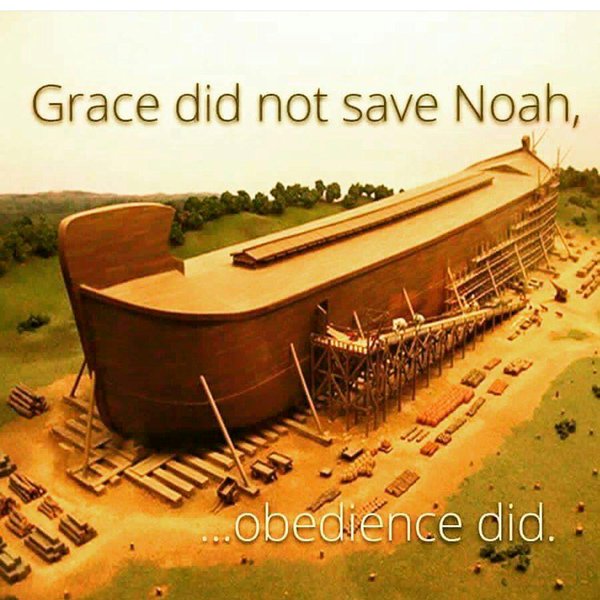
Recently, the image to the right reminded of my heritage, as a Bible Thumping Baptist.

The image didn\’t set right with me, and it took a few moments to process why.  First, it called back to the legalism I was entrench.  Secondly, it touched that old spirit of division and elitism that so easily ensnares all of us through Denominational Doctrine.

It\’s been a while since I\’ve last read Genesis and Hebrews, so I headed back there to re-read the story of Noah.

And what do you think I found?  

Noah was saved by grace, through faith – not through obedience as many would like to believe.

But Noah found grace in the eyes of the Lord (Genesis 6:8)

By faith Noah, being warned by God about things not yet seen, in reverence prepared an ark for the salvation of his household, by which he condemned the world, and became an heir of the righteousness which is according to faith (Hebrews 11:7

But … Obedience!

So then, what do we do with obedience? 

Obedience from the heart is what matters, not obedience for the sake of obedience – and that\’s where my Bible Thumping Baptist heritage took me through \”learning the Bible.\”  They were all about being obedient to God.  Granted, there are many who can consume that doctrine and respond from the heart.  But since Christian denominations are rooted in Doctrine (which divides) rather than Relationship (which unites), I find it very unlikely that Mr. or Mrs. Average Christian actually gets it.  Rather, they find themselves right in the midst of living up to a standard through regular church attendance, singing in the choir, feeding the homeless and knocking on doors:

“What are your multiplied sacrifices to Me?”  Says the Lord. “I have had enough of burnt offerings of rams and the fat of fed cattle; and I take no pleasure in the blood of bulls, lambs or goats.  “When you come to appear before Me, Who requires of you this trampling of My courts?  “Bring your worthless offerings no longer, incense is an abomination to Me.  New moon and sabbath, the calling of assemblies—I cannot endure iniquity and the solemn assembly. (Isaiah 1:11-13)

The modern church doesn\’t need a relationship with God in order to function: they just need charismatic leadership, money and enough nicely designed programs to keep people entertained in their pursuit of pleasing God and measuring up through obedience.  So it\’s not the style of music that drives people away from God, it\’s doctrine without relationship enabled through good works programs.

Paul addressed this problem at Corinth.  He learned early on to not attempt to \”wow\” people with his dexterity of doctrine, but to bring them into an encounter (an experience) with God:

And when I came to you, brethren, I did not come with superiority of speech or of wisdom, proclaiming to you the testimony of God … and my message and my preaching were not in persuasive words of wisdom, but in demonstration of the Spirit and of power, so that your faith would not rest on the wisdom of men, but on the power of God. (1 Corinthians 2:1-5)

But I will come to you soon, if the Lord wills, and I shall find out, not the words of those who are arrogant but their power. For the kingdom of God does not consist in words but in power.  (1 Corinthians 4:19-20)

Conclusion

It wasn\’t obedience that built the Ark, it was the works of faith, based in a relationship with God.

But are you willing to recognize, you foolish fellow, that faith without works is useless? (James 2:20)

Faith and Experience

Fruitful faith has a target or object upon which it is founded. It varies, but it could be reason, experience or a person, among other things. It\’s why we get our word faithful from faith: a faithful person has demonstrated two things: they have the ability to produce (you believe they can do a thing) and they will produce (you trust that they will do as they say). Faith placed in a faithful person always carries an expectation of experience. Such faith is well founded or well grounded because the person has demonstrated themselves to be reliable.

Therefore, faith is not demonstrated by how you feel, it\’s not demonstrated by the beliefs you hold, neither the doctrines you keep

Faith is demonstrated by what is produced: the outcome, the experience.  Faith \”is the assurance of things hoped for, the conviction of things not seen. For by it the men of old gained approval.\”  What happens when the thing not seen and hoped for, shows up?  Faith moves out of the way and gives place to the experience.

Therefore, believing a doctrine for the sake of belief only, is worthless. That is not faith because such belief produces no work, no experience. James summed it up by suggesting that the demons have a proper belief too, but it is to them, worthless.

“But someone may well say, \”You have faith and I have works; show me your faith without the works, and I will show you my faith by my works.\” 

You believe that God is one. You do well; the demons also believe, and shudder. 

But are you willing to recognize, you foolish fellow, that faith without works is useless?” (James 2:18-19)

Therefore, the conviction of the thing unseen must always bring fruit.  You can know if your faith was well place by observing the fruit.  As a matter of fact, you can determine the efficacy of a work or ministry by the same standard – \”you shall know them by their fruit\” (Matthew 7:20)

But the fruit of the Spirit is love, joy, peace, patience, kindness, goodness, faithfulness, gentleness, self-control; against such things there is no law. (Hebrews 11:1)

But the wisdom from above is first pure, then peaceable, gentle, reasonable, full of mercy and good fruits, unwavering, without hypocrisy. And the seed whose fruit is righteousness is sown in peace by those who make peace. (James 3:17-18)

You’ve Already Won the Battle

Count it all joy when you encounter various trials knowing that the testing of your faith will produce endurance (James 1:2-3)

 
But remember this: you will not be tested beyond that which you can handle (1 Corinthians 10:13).
 
So, what’s the deal? This: 

You will not be lead into battles you cannot win, nor are unable to fight. You will only be lead into conflict you can overcome.  Every battle that you encounter, is always a temptation to rely upon self or rely upon God.  Every single one.

Every battle is different, but they all will have one of the following characteristics.
  1. There are battles wherein we are to do nothing but stand or take refuge (2 Samuel 22:3)
    • These are the battles wherein God is demonstrating who He is to you.
  2. There are battles wherein we are to we are wrestle against the enemy.  
    • These are the times when God is demonstrating who you are in Him  (Ephesians 6:10-18).
That testing of your faith, the conflict that’s wearing you down? You need to understand that since you’re in the midst of it, you’re already an over-comer, a victor. You’re in the midst of something you can beat, win and conquer.  The devil may be seeking someone to devour, but not everyone is devoured.
 
So stop sulking and start living.
 
Consider that the Hebrews were lead away from the Egyptians but lead into battle for the Promise Land. Why? They were already defeated against the Egyptians – in their minds, they were slaves, victims, they had already lost: it was a battle they could not win.
 
The first battle for the Promise Land was a shoe-in, but they missed the blessing because they did not have faith – they did not place their trust and confidence in God.
 
So, don’t miss your blessing. Know that there are always two trees in your garden: there must always be something that comes against the promise.  Because without conflict, without choice, there is no growth.  In the process of the battle, pruning/cleansing will take place (John 15:1-5) to remove away those things that don\’t look like Him.
The question you must answer is this
To what do you give your voice, your heart?
The doubt, or the God of the promise?

The Un-Grace of Today’s Piety

I recently spent some time reading the Pulpit&Pen blog and came away thinking it’s not atypical of the un-grace behaviors we observe today in our churches and their pulpits.

So with full knowledge that I most likely will be accused of doing the same, I\’ll put my pen to the subject and provide my opinions on the matter.

What is Grace?

There’s a parable that expresses grace very well, but no one ever teaches it that way.  We’re tied more to un-grace and, as a result, we express that sentiment instead.  It’s called the Parable of the Vineyard Workers and is found in Matthew 20:1-16.

In this parable the kingdom of God is likened unto a man who arose early, went out and found workers, agreed with the laborers a wage and hired them.  He later went out and hired other workers – but without the negotiations: he simply said, “you go into the vineyard too, and what ever is right, I will pay you.”  This happened several times that day, at the third, sixth, ninth and the eleventh hour.  At the end of the day he instructed his foreman to pay all of the laborers, beginning with the last to be hired and ending with the first who were hired.  All of the workers received the same wage, even those who were hired first.  So they who were hired first grumbled, thinking they should receive more.  The vineyard owner said, 

Friend, I am doing you no wrong. Did you not agree with me for a denarius?  Take what belongs to you and go. I choose to give to this last worker as I give to you.  Am I not allowed to do what I choose with what belongs to me? Or do you begrudge my generosity?’  So the last will be first, and the first last.”

Only in our propensity towards un-grace can we see this as a lesson about God doing what He will with you – His prerogative –  and you just needing to suck it up and be happy you got something out of the deal.

But lets look more closely.

This parable does speak towards the right to \”do what I choose with what belongs to me.\”  But the parable has more to do with His generosity than it does with his money.  Observe how the wage was agreed upon:

After agreeing with the laborers for a denarius a day, he sent them into his vineyard.

Did you notice who was setting the wage?  It doesn’t say, “after the laborers agreed with him for a denarius a day.

In other words, the laborers set the wage: they had something in mind, asked for that wage and the owner agreed. All of the other laborers hired that day did not ask for a wage, but were instead encouraged to place their faith in the owner, that he would indeed pay them “whatever is right.”

At the end of the day, the owner paid what was owed to the laborers hired early in the morning.  But he poured out generosity – grace – upon those who chose to trust in his good nature, his integrity: that he would do as he promised.

Generosity and Trust

So then, this parable isn’t teaching about God’s prerogative, that you just need to buck up and accept your lumps.  It’s teaching about the generosity of God: that He can be trusted to be generous – just as the owner was trusted to make good on his word: “I will pay you what is right.”

And as a side note, it’s suggesting that it’s best to let God decide how to reward you rather than asking for recompense yourself: the last will be first, and the first last.  When you set the rules, you\’re saying “I’m first.”

What is Un-Grace?

So what exactly is un-grace?  Quite possibly the best explanation can be found in Philip Yancey’s book, “What’s So Amazing about Grace?,” but I’ll give it a bit of a go here.

Un-grace is expressed in many different forms.  One form is legalism: un-grace asserts one must work for a proper standing.  Un-grace makes people pay for their mistakes.  Un-grace condemns rather than builds up.  Un-grace requires repentance before forgiveness.  Un-grace is relentless in it\’s exposure of the sins of others.  Un-grace strips a person naked and exposes their shame.  And un-grace calls others stupid and dumb when they don’t meet expectations.

Another way in which un-grace is expressed is when the Bible is used as a sword against believers, or people in general – something I’ve been guilty of many times.  So “what’s wrong with that,” you might ask?  Plenty.  Lets allow scripture speak to the issue in order to understand why.

The Sword of the Spirit

In the book of Ephesians, Paul equates the word of God to the sword of the Spirit; specifically, to be used against the enemy:

Finally, be strong in the Lord and in the strength of his might. Put on the whole armor of God, that you may be able to stand against the schemes of the devil.  For we do not wrestle against flesh and blood, but against the rulers, against the authorities, against the cosmic powers over this present darkness, against the spiritual forces of evil in the heavenly places.  Therefore take up the whole armor of God, that you may be able to withstand in the evil day, and having done all, to stand firm.  Stand therefore, having fastened on the belt of truth, and having put on the breastplate of righteousness, and, as shoes for your feet, having put on the readiness given by the gospel of peace.  In all circumstances take up the shield of faith, with which you can extinguish all the flaming darts of the evil one;  and take the helmet of salvation, and the sword of the Spirit, which is the word of God, praying at all times in the Spirit, with all prayer and supplication. To that end keep alert with all perseverance, making supplication for all the saints

Eph. 6:10-18

Paul clearly states that “supplication” is to be made for the saints – not “use the word of God” to wrestle against the saints.  Secondly, these things – as enumerated by Paul above – are known as the “weapons of our warfare” (2 Corinthians 10:3-5).  No where in scripture are we exhorted to take up spiritual weapons against people.  Quite the contrary: we are encouraged to bless those who curse us (Luke 6:28).

Consider also ,,,

Brothers, if anyone is caught in any transgression, you who are spiritual should restore him in a spirit of gentleness. Keep watch on yourself, lest you too be tempted.

Galatians 6:1

The point, therefore is this:  the sword of the spirit is not to be used against people: it is to be used against our common enemy.  Anyone overtaken or caught (eaten before others is the idea in the Greek – Satan seeks to devour: 1 Peter 5:8) is to be restored in gentleness.  But that is not what we do, that is not what we see happening.  What we observe is outright condemnation and vile disparaging, the laying bare and casting of shame.  And if there is no condemnation for those who are in Christ Jesus, then what right do we have to condemn others?

Who are you to pass judgment on the servant of another? It is before his own master that he stands or falls. And he will be upheld, for the Lord is able to make him stand. ()

Romans 14:4

Deceitful Religion

James is one of my favorite Bible authors.  He is incredibly deep: with few words he packs incredible amounts of truth.  Consider the following:

If anyone thinks himself to be religious, and yet does not bridle his tongue but deceives his own heartthis man\’s religion is worthless.  Pure and undefiled religion in the sight of our God and Father is this: to visit orphans and widows in their distress, and to keep oneself unstained by the world.

James 1:26-27

First, what is a religion?  In its simplest form, religion may be defined as a particular system of faith (beliefs) and worship (actions).  That definition certainly fits a belief system resulting in works.

Secondly, he’s not condoning religion.  While he refers to those who have and express a religion through words, he’s careful to define a pure religion through action: tending to orphans and widows in need, and keeping oneself unstained from the world (hardly an apt definition of Christianity today).

Finally, consider that the great commission did not include an admonition to keep one’s self unstained – that’s simply to say this: we’re not commissioned to pursue moral purity, we’re commissioned to be witnesses (Acts 1:8;  moral purity is a topic for another blog).

However, what we want to pay attention to from James’ admonition is this bit of truth:

those who do not bridle their tongues, practice a religion of deceiving their own hearts

In other words, James is asserting that we can express our religion through our speech.  And an unbridled tongue is the evidence required to expose a worthless religion.

Bridle

Let’s make sure we understand bridle.  It means to hold in check, to restrain – so James is referring to those of us who do not keep in check, or restrain our tongue, our speech – which is sourced from our thoughts, ideas and imaginations.  

Deception

Jesus addressed deception and lies when He said, \”you will know the truth and the truth will make you free\” (John 8:32).  If knowing truth sets you free, then what does knowing a lie do?  It does the exact opposite: it puts you into bondage, into a stronghold.  And scripture is clear on what we\’re to do with strongholds:

For though we walk in the flesh, we do not war after the flesh: (for the weapons of our warfare are not carnal, but mighty through God to the pulling down of strong holds;) casting down imaginations, and every high thing that exalts itself against the knowledge of God, and bringing into captivity every thought to the obedience of Christ; (2 Corinthians 10:3-5)

Our Heart

Finally, we need to understand that our speech reflects our inner most being:

Watch over your heart with all diligence, for from it flow the springs of life (Proverbs 4:23)  

For as he thinks within himself, so he is.  He says to you, \”Eat and drink!\” but his heart is not with you. (Proverbs 23:7)

In Conclusion 

James is saying this: “when you do not bridle your tongue (when you speak condemnation), you may believe you’re doing well, but you’re not: you’re deceiving yourself and practicing a religion based in self deception.\”

In condemning others, we may find ourselves using the Bible as a weapon against people: that’s the deception of our hearts, the tongue unbridled, as James called it.  Condemnation is un-grace, it is the opposite of restoring someone in gentleness.

But the wisdom from above is first pure, then peaceable, gentle, reasonable, full of mercy and good fruits, unwavering, without hypocrisy. And the seed whose fruit is righteousness is sown in peace by those who make peace.

James 3:17-18

Is Cursing a Sin?

Sin is more subtle than missing the mark or disobeying God, the Word, etc., etc. We need not a better definition, but another attribute to carry with our definitions.

Consider: \”Thy will be done, on earth as it is in heaven.\”
That idea, imagination or word – as some would say – carries a tremendous weight of possibilities. But I want to focus on one aspect, that being the idea of a reality. Heaven is a reality distinct from our own, a place where sin does not exist. But just because a reality doesn\’t look precisely like Heaven, doesn\’t mean it\’s sinful.
Consider that all things were created to live, reproduce and die. In other words, things would be born, grow, reproduce, suffer corruption and die – trees, fish, cows, etc., etc. That was the plan, that all would bear fruit after their own kind (Gen. 1:11, ff). Think of it this way: there was always a hungry, bigger fish; or a whale chomping on plankton or sea weed. These are realities distinct from heaven, but not sinful in their own right.
When Adam and Eve sinned, what did they do? They asserted their imagination, their reality contrary to that which was designed. In doing so, they brought upon themselves spiritual separation from God – they created an inferior reality for themselves.
So what\’s the point? Add to your definition of sin, this: a state of reality expressed that is inferior to purposed design. And in doing so, remember that which is not of faith, is sin – or, inferior to God\’s design.
So, is cursing sin? Consider it in the context of 1 Corinthians 14:3, \”But one who prophesies speaks to men for edification and exhortation and consolation.\” We can then understand that corrupt communication (Eph. 4:29) is not prophecy. 

It is inferior to God\’s purposed design.

On Being a Bunny Hopper

Today I became a Bunny Hopper

Well, not exactly.   Let me explain.

Back in the day, when the church doors were open, I was there.  Sunday mornings (sometimes twice), Sunday School, Choir or Orchestra, Sunday evenings and Wednesdays.  If I had the time, I showed up for evangelism on Tuesday nights.  Later in life, I became a Sunday school teacher for a while.

One of the things that irritated me most was Easter.  Not Easter itself, but all of the people who otherwise never darkened the doors – who for what ever reason – showed up on Easter.  What right did they have to be all pretentious and some how think they could make right for all of the wrongs on one day out of the year?  I called them Bunny Hoppers – they hop in once or twice a year, and then hop out.  I\’m going to guess that there are a number of people who believe or feel similar to how I felt, in that regard.

For you see, I earned my position within the church, I worked for my right to be there and partake of the family, the friends and the worship.  They, the Bunny Hoppers, weren\’t there at all the rest of the time – so why right did they have to show up and ruin it for everyone else, or presume they were even half as spiritual as anyone else?

Eventually, things changed for me.  I began to see todays\’ Church for what it was, an Institution – divergent from the Assembly, the Ecclesia – a construct made mostly by man, driven to collect tithes and maintain a status of quo of laity vs. clergy, men vs. women; filled with teachers of the traditions of men and people comfortably numb to the Spirit and Truth.

I came to the place where I could no longer tolerate the doctrine of \”God doesn\’t do that any more,\” so easily taught in complete conflict with what is in the Bible.  So I excused myself from the Institution.  The day I left, my Sunday School Director said to me, \”you\’re an out of the box type of person,\” and motioning to the walls around us said, \”and this is the box.\”

Today, worship is no longer what I do on Sundays, its\’ something I do every day.  On one day a week, I rest – usually that\’s Sunday.  To me, the assembly is family and friends in the Lord – people who can speak into my life because they know where I am, what I\’m doing, how I\’m living in Christ.  To put it bluntly, a Pastor can\’t do that.  They can cast a wide net, but that\’s about it.

If you\’re in a Evangelical church, you\’ve heard the Gospel three dozen different ways; and if you\’re a good christian, you\’ve re-examined yourself ten times that amount.  But in actuality, the Gospel was efficacious once – beyond that, we don\’t need to hear it again: so what good has repeating it done us?  We hear the Gospel being preached yet again from the pulpit and somehow think that\’s what it\’s all about: let the ministry save the people, not the priests sitting in the pews.

The Church, the Ecclesia, has been corrupted.  We show up, sit down, shut up, pay up, get up and leave.  And if you\’re really spiritual, you\’ll do it all over again in Sunday School.  Where exactly is that modeled in our scriptures?  And therein is the problem: it\’s not.  We\’ve been duped into a false sense of security, spiced with condemnation and guilt for not paying our tithes and serving the pastoral staff.

So I bowed out (more or less), and set out on a journey to find Jesus, rejecting the notion – as I was taught in my church – that The Church is Jesus and by bringing people to The Church, we\’re introducing people to Jesus.

Eventually, I joined another church and their Community Group – they didn\’t have Sunday School, which was more than fine with me.  The Community Group was a place were we could discuss life and things we were learning in Jesus.  That suited me just fine.  I actually preferred the small group setting to the large congregation.  I found myself going there more than I went to Church.

So today, I found myself going to Church on Easter.  Just like all of those other people, whom several decades ago, I condemned because they hadn\’t earned the right to be there in the first place.

I had become what I loathed: a Bunny Hopper.

But today was different.  Today it didn\’t matter to me where anyone had been, or why they were there, or why they might not have been there consistently in the past.  I injected no presuppositions of spirituality (the lack thereof) upon their souls.  I didn\’t consider them as being spiritually aware as a brick, or spiritually stupid as I have known other people to do.  And most of all, there was no self condemnation – which is a miracle in-and-of itself.

I found that instead of saddling them with rules, regulations and condemnation, I had found that suddenly, I was able to extend grace.  I wanted to build them up, not instruct them on how to better live their lives or to measure up to a standard; I found myself not judging them for any perceived or imagined lack of prior participation.

So when the invitation came, I ignored the pastoral instruction to close my eyes.  I found two people raising their hands, indicating they wanted to know Jesus – to pray the \”sinner\’s prayer,\” as we called it.  So I prayed for them, I blessed them, I stored up some treasure in heaven.  And I walked away knowing that my prayers were impactful, not because of who I am in and of myself, but because of who I am in Christ – a King and a Priest (Rev. 1:6).  This means I have the authority to affect change in the natural (as a King) and to affect change in the Spiritual (as a Priest).  It\’s my identity.

So today I learned that I\’ve become something better than I was decades ago.  I\’ve not been stagnant, I\’ve changed, I\’ve grown – I\’ve produce fruit of the spirit.  Not because I tied it on like I used to, not because I picked it up and purposed to do it: because it is a natural by-product of who I have become.

If that makes be a Bunny Hopper, then so be it.  I\’ll take that any day over who I was in the past.

A Brief Synopsis of Modern, Western Christianity

We\’ve exchanged the higher purpose of making Disciples and Worshipers for making Christians.

The problem is this: to make a modern, Western Christian, we must add our doctrine, our Traditions of Men and our varied philosophies in order to successfully mold one into our image.  We call them Baptists, Methodists, Presbyterians and Catholics – just to name a few.

This is precisely why The Church, and most Christians, are almost universally known more for an adherence of a given set of rules than for Grace or Love.  They demand adherence to form and function, rules of law rather than being known because of their love.

It is why we, as Church Members, demand purity over substance, demonstration over Love.  We demand that our new members clean themselves up and demonstrate proper, spiritual etiquette before being accepted into the clique.

In another vernacular, it\’s known as legalism – a system practically void of Grace and Love; a system designed to improve the external to acceptable standards, to shackle the broken hearted and obfuscate the Truth that could set them free.

God does not desire our worship, and He does not force people to worship Him.  God desires worshipers, not worship.  There is a distinct and significant difference.  Anyone can worship anything.  But only a true worshiper of God is changed from the inside out, into the image of Christ – a true Disciple.

It is the difference between tying fruit onto a tree with string that rots and is good for nothing, and becoming the tree that bears fruit to nourish all who partake of it.

\”But an hour is coming, and now is, when the true worshipers will worship the Father in spirit and truth; for such people the Father seeks to be His worshipers.\”  (John 4:23)  

\”and you will know the truth, and the truth will make you free\” (John 8:32

\”These signs will accompany those who have believed: in My name they will cast out demons, they will speak with new tongues; they will pick up serpents, and if they drink any deadly poison, it will not hurt them; they will lay hands on the sick, and they will recover.” (Mark 16:17-18