Personal Forgiveness


There is a fallacy maintained in our churches today, and it is this: forgiveness and turning the other cheek go hand in hand, and forgiveness should look like, be like and feel like turning the other cheek.

Nothing could be further from the truth. Turning the other cheek is one of two things: it is either getting what you know you deserve, or it is a subtle rebuke which will drive the repentant to confession and reconciliation. In the worst case, you will be slapped again, and having no more cheeks, you turn and leave.

In regards to forgiveness, wise people will tell you something like this: “forgiveness does not mean you allow yourself to be run over by the same bus more than once.” Doing so is passivity which results in further damage and resentment towards the bus driver and yourself.

The two types of forgiveness

There are two types of forgiveness: personal forgiveness and reconciliation forgiveness. In this post, we will explore the necessity of personal forgiveness.

Why Forgive?

Forgiveness is necessary because the damage has been caused to you. Someone did something to you that caused some type of damage. It’s as if you are a car and someone smacked you with a sledgehammer, leaving a large hole in your fender. Forgiveness is necessary because you’re damaged, physically and/or emotionally.

If you’re like most people, you may be thinking that forgiveness opens you up to another attack. No, actually, it does not. What opens you up to another attack is an improper boundary. If you’ve been robbed because your door was unlocked, and you refuse to lock your door after the robbery, then you are partially responsible for subsequent robberies. Should the robber keep out of your house? Of course, he should. Should you erect the proper boundary, in this case, a locked door, to keep future attempts at bay? Most certainly, you should. So then, forgiveness does not obliterate proper boundaries; rather, it has the potential to enable you to erect proper boundaries in the future.

While you’re holding onto unforgiveness, you are not in any way hurting the offender, nor are you protecting yourself. The way you protect yourself is by erecting a proper boundary, by locking the door. But this doesn’t negate that fact that you still have damage, something has been stolen. The robber is perfectly happy with your goods, and you’re perfectly unhappy without them.

It’s about letting go

Personal forgiveness is the mechanism that begins the process of releasing us from the damage caused by others. Until you can let go of the damage caused by others, you will continue to suffer in that damage in which you maintain.

If someone threw a rock through your window during the middle of the winter, do you fix the window, or do you maintain anger against the person who broke your window? You fix the window because you’re cold, and your heating bills will break the bank.

What sense is there in leaving the damaged window and maintaining anger against the person who threw the rock when you’re the one suffering? The logical thing to do is fix the window and ask the person who broke it to pay for the damages because to make you whole is what he owes you.

When we choose not to forgive, we chose to hold on to damage, and in doing so, we become bound to the damage – we are in bondage to the pain, the suffering, and they hurt. Furthermore, failing to forgive causes more damage than the actual offense: you’re living the hurts continually. Failing to forgive does nothing to the one who hurt you, but it causes a root of bitterness to grow deep, strong, and hard in your heart.

What is Personal Forgiveness?

Personal forgiveness is a private, volitional exercise that we perform so that we may be released from the bondage of the damage caused by those who sinned against us. It is the forgiveness is spoken of in the Lord’s Prayer –

… and forgive us our debts, as we forgive our debtors … (Matthew 6:12)

In this type of forgiveness, we do two things: we release the offender from their obligations to repair the damage they caused in us, and we release ourselves from bondage to the damage in us.

This type of forgiveness is not tied to the offender repenting of their sins, nor is it tied to the offender saying they’re sorry. Sometimes the offender cannot repent or refuses to speak to you, or worse, they’re dead. In this type of forgiveness, the participation of the offender is never required.

Condemning the Damage

Personal forgiveness requires that you call sin what it is: sin. If you don’t mind people robbing your home, then you’ll leave the doors open and replace all of the things people take just so those things can be stolen again. In this case, you’re not agreeing with the sin, you’re not condemning the sin, and you’re not calling it wrong. But God has given us a permission to call a spade a spade:

“No weapon that is formed against you will prosper, and every tongue that accuses you in judgment you will condemn. This is the heritage of the servants of the LORD, and their vindication is from Me,” declares the LORD. (Isaiah 54:17)

You have a right and obligation to call offenses and sin what they are: sin. We refuse to condemn the sins against us; we are in effect calling them blessings and goodness.  If you don’t call it wrong (condemn it), then you have no place to forgive, for how does one forgive the good done by another? Good is not forgiven, it is praised, and thanksgiving is offered.   

Avoiding a Root of Bitterness

See to it that no one comes short of the grace of God; that no root of bitterness springing up causes trouble, and by it many be defiled

Hebrews 12:15

Unforgiveness results in bitterness. But forgiveness is the key that opens the pathway to grace. And grace is that thing that makes you into something that you cannot become on your own. When your car is damaged by someone else, they typically have insurance that makes you whole again. But if they don’t, you can call your insurance company, and they will make you whole.

In personal forgiveness the participation, or repentance of the offender is absent. It’s as if they hit you and ran away. But God is your insurance company, and He will make you whole again. But, you have to be willing to condemn the sin (agree that it was wrong) and report the offense to God, and then release the offender from their responsibility to you. Once you’ve released them of their obligation to you, then you have enabled God to make you whole.

Personal Forgiveness is not Reconciliation

You cannot be reconciled to someone who is dead, but you can forgive them.

Reconciliation is not the goal of personal forgiveness. Personal forgiveness is not for the offender and it is not for restoring the relationship with the offender, it is for you, your freedom and your relationship with God. Personal forgiveness always frees you to pursue reconciliation with the offender, should they be available and participatory.

When we take our hurts and our damage to God, He makes us whole. But only when we choose to let go can we be free of hurts. Personal forgiveness not only releases us from the damage caused in us by others, it is also the mechanism by which we maintain or re-establish communion with God in the midst of the trial caused by other people.

When we do not forgive, we shy away from God and hide from Him. When we harbor bitterness in our hearts, we damage our walk with God. When Adam and Eve sinned in the garden, they hid from each other and hid from God. Jesus said, “whenever you stand praying, forgive, if you have anything against anyone, so that your Father who is in heaven will also forgive you your transgressions.” (Mark 11:25) Having something against another is sin – it is something that you must confess. The Law of Bitterness ensures that your relationship with God suffers while you suffer in un-forgiveness.

Conclusion

When we fail to forgive, we hold onto something that is not ours: we hold onto the damage caused and created by someone else. Ultimately, we allow the person of offended us to continue an additional offense.

Personal forgiveness is the gateway to eradicating or preventing a root of bitterness. It’s not necessarily easy, and you may find that you pick up the offense again and again. But when you do, just take the offense back to God and forgive again. Eventually, you will find God has honored his word by restoring you to the place you were before the offense, and by giving you an additional blessing to move you forward in your relationship with Him:

Return to the stronghold, O prisoners who have the hope; this very day I am declaring that I will restore double to you. (Zechariah 9:12)

You can read my post on reconciliation forgiveness, here.

What’s so special about Christianity?

Every religion has a method by which one may obtain a desired state of being, which in this discussion will be called salvation.

In a generic definition, salvation may be seen as a state of being. A state which in it’s ultimate form, is absent of pain and suffering (whether inflicted upon us by ourselves or others) and free of sin. Sin is defined as the propensity of man to disobey (one or more times) a given moral law or code.
Thus, salvation is seen as the ultimate condition to which a person may aspire, and it is defined in contrast to man in his worst condition – as he is, living on earth in pain, suffering and sin. Salvation, therefore, is man being saved from the a condition of sin and suffering into a perfect state of being where the grip of pain, suffering and sin does not exist, neither can it ever lay hold upon man again.

Every Religion Has It

Every religion defines a process by which the undesirable is made null and void, hence salvation obtained.

The question many people have, or at least consider, is this: what must I do in order to be free of sin, what must I do to be free from pain and suffering? To answer that question, we\’re going to briefly review Buddhism, a religion that has touched the lives of many pious people. By doing so we will provide a general foundation by which other religions can be understood. Once we’ve done that, we’re going to answer the question, “what’s so special about Christianity?”

Buddhism

Buddhism identifies the burden of life in the two-fold problem of sin and suffering. The question Gautama Buddha (the founder of Buddhism), sought to answer was, “why is there pain and suffering?” In addition to this, he also held a belief common to Hinduism called reincarnation – being reborn to an earthly life in either an higher or lower form. So, one might return as a man, woman, a flea or a rat, depending upon one’s good and bad deeds in the previous life. The point of reincarnation is ascension to a higher form all the while shedding that which encumbers you from reaching enlightenment, and subsequently, Nirvana.

How does one ensure they reach Nirvana? It is obtained via the eight-fold path, which is defined (briefly) as follows:

The “Right” …

  1. Views. One must accept the four noble truths
  2. Resolve. One must renounce all desires (lust, bitterness, cruelty, selfishness)
  3. Speech. One must speak only truth.
  4. Behavior. One must abstain from sexual immorality, stealing, and all killing.
  5. Occupation. One must work in an occupation that benefits others and harms no one.
  6. Effort. One must seek to eliminate any evil qualities within and prevent any new ones from arising.
  7. Contemplation. One must be observant, contemplative, and free of desire and sorrow.
  8. Meditation. One must be disciplined in meditation in order to overcome sensations of pleasure and pain so that one may enter a state of transcending consciousness and attain a state of perfection.
Therefore, in the most basic of statements, Buddhists believe that through self effort one can attain the state of peace and eternal bliss called Nirvana, or salvation. This effort which results in salvation is called atonement. Atonement is compensation for wrongdoing.

It’s no Different Elsewhere

Seriously, it’s not that much different in any other religion. In any of the world’s religions the most basic tenant is this: man through his efforts provides his own atonement for his condition. Some people obey the Four-Fold Truths and the Eight-Fold Path resulting in Nirvana. Others place their faith in a creed followed by doing good works and possibly obtain the favor of their god resulting in salvation (The Five Pillars / Islam). And yet others follow another type of creed and/or asceticism that they hope will result in a type of liberation.

Christianity: There’s Good News and Bad News

In Christianity, there’s good news and bad news. Isn’t there always? Someone always asks you “do you want the good news first, or the bad news first?” Most people prefer to receive the good news first – they think it will soften the bad news, but it never does. In lieu of this, someone once said, “do the hard part first and the easy part last, then the easy part will be easier.” So that’s what we’re going to do here – you get the hard part first.

The Bad News

You’re dead, spiritually speaking that is. God said to Adam and Eve, “if you eat from that tree, then you will die.” And Adam and Eve did die, spiritually speaking. And just like some of us inherited blue eyes and blond hair form our mother, we inherited spiritual death from Adam. That’s the root of the suffering, pain and sin that we see and experience in the world today


It doesn’t feel too good, does it, thinking of ourselves as spiritually dead sinners? What we really want, deep down, is to be free from the bondage of sin and suffering. So we like to think better of ourselves – we don’t sin that much and we do a lot of good things, surely God takes notice. In a real sense, you’re correct: God does take notice and we will be judged according to our deeds, but you can no more enter a Corvette into a Formula-1 race, or make an apple pie with pork chops, than you can make a spiritually dead man persist in the presence of a living God for all eternity: they don’t mix – death cannot comprehend life.

God is a Spirit: and they that worship him must worship him in spirit and in truth.
As thou knows not what is the way of the spirit, nor how the bones do grow in the womb of her that is with child: even so thou knows not the works of God who makes all
They will not frame their doings to turn unto their God: for the spirit of whoredoms is in the midst of them, and they have not known the LORD.

More Bad News: It’s Your Nature

When was the last time you went to a funeral and heard the deceased give the eulogy? When was the last time you used wholly rotten apples in an apple pie? When was the last time an aborted baby re-assembled itself, came back to life and punched the Dr. in the family jewels? It doesn’t happen – death cannot comprehend, abide or persist with life. Think of it this way: as a spiritualy dead person, you’re a penny. In God\’s Coke machine of Eternity, only quarters make it to the money box, pennies are ejected out the bottom. You don’t fit, you’re the wrong size, you\’re spiritually misshapen to abide in spiritual life after physical death. That which is spiritually dead remains spiritually dead after physical death.

More Bad News: You’ve Got the Wrong Currency for Atonement

As a Spiritually dead person, not only can you not abide in life, you’ve got the wrong currency needed for atonement. Every time you sin, you earn wages. That sounds about right, doesn’t it? Paid for the bad things, paid for the good things, and if the good out-weighs the bad, then you’re in like Flint. Wrong. You’re getting paid with – you guessed it – death.
For the wages of sin is death, but the free gift of God is eternal life in Christ Jesus our Lord.
But, what about all the righteous things you do? Surely my righteous deeds can wipe away my death, right? Lets take a look:
For all of us have become like one who is unclean, and all our righteous deeds are like a filthy garment; and all of us wither like a leaf, and our iniquities, like the wind, take us away. There is no one who calls on Your name, who arouses himself to take hold of You; for You have hidden Your face from us and have delivered us into the power of our iniquities.
Our righteousness deeds cannot cleanse our death – who among us uses a greasy rag to clean a window? What’s the point? It will be no better than when you started. Secondly, since the the power of your iniquities is death, when you die physically you will spend eternity reaping spiritual death:
… who shall be punished with everlasting destruction from the presence of the Lord, and from the glory of his power …
And I saw the dead, small and great, stand before God; and the books were opened: and another book was opened, which is the book of life: and the dead were judged out of those things which were written in the books, according to their works. And the sea gave up the dead which were in it; and death and hell delivered up the dead which were in them: and they were judged every man according to their works.

God has a Pattern – A Method Resulting in Eternal Spiritual Life

God’s method and pattern is simple:
  1. God’s Redemption
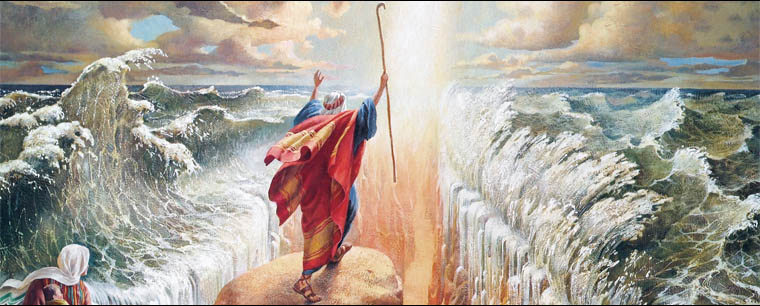
The first step in God\’s pattern is redemption. The Israelites were redeemed by God from the bondage of Egypt. If the Israelites could have left the bondage of Egypt on their own, without a savior, without a redeemer, without the action of God, then they would have. What they needed was a deliverer, which is what they got:
And it came to pass in the course of those many days that the king of Egypt died; and the children of Israel sighed by reason of the bondage, and they cried, and their cry came up unto God by reason of the bondage. And God heard their groaning, and God remembered His covenant with Abraham, with Isaac, and with Jacob. And God saw the children of Israel, and God took cognizance of them.
Wherefore say unto the children of Israel: I am the LORD, and I will bring you out from under the burdens of the Egyptians, and I will deliver you from their bondage, and I will redeem you with an outstretched arm, and with great judgments; and I will take you to Me for a people, and I will be to you a God; and ye shall know that I am the LORD your God, who brought you out from under the burdens of the Egyptians. And I will bring you in unto the land, concerning which I lifted up My hand to give it to Abraham, to Isaac, and to Jacob; and I will give it you for a heritage: I am the LORD.\’
  1. God\’s Law
The second step in God\’s pattern is Law. After the Israelites were redeemed and given a new life in the promised land, He gave them the Law – a basis by which they were to live their lives and understand their relationship with Him and others:
And it shall be for a sign unto thee upon thy hand, and for a memorial between thine eyes, that the law of the LORD may be in thy mouth; for with a strong hand hath the LORD brought thee out of Egypt. Thou shalt therefore keep this ordinance in its season from year to year.
And thou shalt teach them the statutes and the laws, and shalt show them the way wherein they must walk, and the work that they must do.
And Moses turned, and went down from the mount, with the two tables of the testimony in his hand; tables that were written on both their sides; on the one side and on the other were they written. And the tables were the work of God, and the writing was the writing of God, graven upon the tables.
  1. God\’s Temple
The third step in God\’s pattern is the Temple – the place you commune with God.
And the LORD spoke unto Moses, saying: \’On the first day of the first month shalt thou rear up the tabernacle of the tent of meeting. And thou shalt put therein the ark of the testimony … Then the cloud covered the tent of meeting, and the glory of the LORD filled the tabernacle.
First, we must be redeemed. Redemption results in spiritual life. It takes us out of the bondage of sin (Egypt – spiritual death) and into the freedom of life (the promised land – spiritual life).
Second, we listen to and understand the Law which results in knowledge for two things: proper relations with our fellow man, and our ability to do the third thing …
Which is communion with God.

Man has a Pattern – A Method Resulting in Eternal Death

Mankind does not like God\’s pattern – we like being in control of our destiny, we like proving that we\’re able to do it ourselves, and we like being able to say that we are better than someone else. So we want to take control and do God\’s plan backwards, assuming all the while that it will be acceptable to Him.
  1. Our Temple (Worship)
First, we worship at our temple. Call it what you may, be it a lifestyle of asceticism or church on Sundays, man has a way in which he worships that which he believes will provide eternal value to him.
  1. Our Law
Second, through his worship man believes he will be changed by gaining knowledge of law and shedding of sin (pain, suffering, etc) which will improve his relations with mankind, resulting in good deeds.
  1. Our Redemption (Heaven – Enlightenment – Nirvana )
Third, through his knowledge of the law and the resulting improved relations with himself and his fellow man, he believes that he will atone for his misdeeds, thereby redeeming himself before his god, in that the good deeds will out-weigh the bad deeds.
That is the absolute basis of every world religion, with the exception of Christianity.

What\’s So Special About Christianity?

Grace. Grace is the single, defining quality of Christianity – no other religion in the world has it.
In Christian circles, grace is poorly defined by an an acrostic:

What is Grace?

Grace is a gift which makes you become something, gives you a position that you cannot be or achieve through your own actions or merit. For example, a fireman rescuing a non-breathing victim and resuscitating them – Grace. Rescue workers digging victims out of the ruble of an earthquake – Grace. Giving a jobless person a job just because you can, not because he/she is qualified for the position – Grace. Providing a home to the homeless – Grace. Making someone your spouse – Grace. Human life – Grace (it\’s a gift given through the the graciousness of the mother and father).
Releasing the Israelites form the bondage of Egypt – Grace.
Grace is that external force acting upon a thing by which the means of becoming something better is provided. Grace provides improvement that cannot be obtained without the provider. A grain of wheat cannot become a stalk full of life giving seed by itself. It must fall to the earth, and it must have water and sunshine. It needs an external force acting upon it before it can transform from death into life.

You Need the Potter

What you need is something to make you alive. You need something to make you into that which you cannot become by yourself – you need grace. Consider again these verses from the Old Testament:
For all of us have become like one who is unclean, and all our righteous deeds are like a filthy garment; and all of us wither like a leaf, and our iniquities, like the wind, take us away. There is no one who calls on Your name, who arouses himself to take hold of You; for You have hidden Your face from us and have delivered us into the power of our iniquities. But now, O LORD, You are our Father, We are the clay, and You our potter; and all of us are the work of Your hand. Do not be angry beyond measure, O LORD, nor remember iniquity forever;

We are the clay? He is the potter? He is our Father? What does that mean?
It means you\’re a penny, not a quarter. It means you\’re an unfired mound of clay, not a bowl useful for good works. It means He is the one that makes the dead come alive. It means that you cannot, through any amount of self discipline, work or asceticism make yourself alive – you need Grace – you need an external force making you into something you cannot become through your own efforts.

The Good News

The good news is that positionally, you\’ve won the lottery. That\’s right. In the Death vs. Life quandary that you find yourself, you\’ve been given the winning ticket as a birthday present. The present is this: your sins have already been judged, in Jesus Christ:
For while we were still helpless, at the right time Christ died for the ungodly. For one will hardly die for a righteous man; though perhaps for the good man someone would dare even to die. But God demonstrates His own love toward us, in that while we were yet sinners, Christ died for us. Much more then, having now been justified by His blood, we shall be saved from the wrath of God through Him
For if, when we were enemies, we were reconciled to God by the death of his Son, much more, being reconciled, we shall be saved by his life. And not only so, but we also joy in God through our Lord Jesus Christ, by whom we have now received the atonement.
Well, you might ask, if that\’s so, then why do some people go to hell, and others go to heaven? That\’s a good question! The answer is simple – Faith – in God\’s order.
In order to get the money from the Lottery Commission, you have to exchange the winning lottery ticket for the cash. You\’ve got to make the trip to the lottery office, sign the ticket and turn it in to the officials. You have to trust and believe (provide faith) that the lottery officials will give you the money in exchange for your ticket. If you don\’t apply that little bit of faith and act upon it, then you\’ll never get the money you\’ve won.

A Righteousness that\’s not Yours

But what if you don\’t believe they will give you the money? What if you believe someone will steal the ticket from you on the way to the lottery office? What if you believe you\’ll lose the ticket on the way there? If you believe those things, then you will live in and act out those beliefs and in doing so, you will stay in your home, clutching a winning lottery ticket, but never receive the money that belongs to you.

In the very same way you must also turn away your arrogance that you can become righteous in and of yourself. You must be willing forsake those things which keep you away from placing your Faith and Trust in God. You must be willing to receive His righteousness through His redemption, before doing the deeds of the Law or the self sacrifice of Worship which cannot, and never will, result in redemption, atonement or salvation.

How is Grace Obtained?

So how is this grace given? Exactly like it was given to the Israelites. Look again:
What does it take to cry out to God? It takes faith. And what is faith? It is believing that God is (as the Israelites did when the cried out to Him), it is believing and trusting that God will do what He said He will do.

But isn\’t faith works?

No, faith is not works. Faith is trusting and believing, and when you trust and believe, you produce works, as in crying out to God, as in the trip you make to the lottery office. Before you can cry out to God, you must believe He is. Before you can make that trip to the lottery office, you must trust and believe that they will honor

Therefore, grace is provided through trust and belief (faith) that God has done and will do the work for you, through the atoning work of the High Priest, Jesus Christ.

Once the Israelites were out of Egypt and had received the Law and the Temple (take note of the order – redemption, law, temple) atonement for common sins was provided through grace, by faith in the Word of God. This faith was acted out through the those who brought the sacrifices and through the actions of the High Priest. It was the priest that made the offering, but God who made it acceptable.

Why did He make it acceptable? Because of their faith. How did He make it acceptable? By His Grace.

Through these actions, God provided an imperfect picture of the perfect sacrifice to come, of the perfect High Priest, Jesus Christ on the cross, by which He Himself entered into the Spiritual Holy of Holies – rather than the earthly holy place found in the earthly temple – thus making a way of salvation for all mankind, not just the Israelites.

God Provides Atonement and Salvation By Grace Through Faith

And, behold, the word of the LORD came unto him
This I recall to my mind, therefore have I hope. Surely the LORD\’S mercies are not consumed, surely His compassions fail not. They are new every morning; great is Thy faithfulness. \’The LORD is my portion\’, saith my soul; \’Therefore will I hope in Him.
For the promise to Abraham or to his descendants that
But God, being rich in mercy, because of His great love with which He loved us, even when we were dead in our transgressions, made us alive together with Christ (by grace you have been saved), and raised us up with Him, and seated us with Him in the heavenly places in Christ Jesus, so that in the ages to come He might show the surpassing riches of His grace in kindness toward us in Christ Jesus.
The point is this: God has done the work, the High Priest, the Christ, has done His job: He has made the sacrifice. Our job is to humble ourselves before Him, accept the work He has done and turn away from our arrogance, our sins, and our disbelief. Through faith we can be clay in His hands, and be made vessels of Grace.
When we place our trust and belief in Him, He will do precisely what He promises to do: provide Salvation by Grace through Faith.

Faith – A Definition and its Application

Without faith it is impossible to please Him, for he who comes to God must believe that he is and that He is a rewarder of those who seek Him. (Hebrews 11:6)

The World\’s Definition of Faith
According to the world, faith is an ethereal, empty, mustered up belief of wishing in the impossible or improvable. It has been defined as belief in something that does not rest in logical truth. Many times the definition involves a belief in a given religion, dogma or denomination associated with various sects of Christian or non-Christian systems of belief.
A Proper Definition of Faith
Faith is a confident belief in the truth, value, or trustworthiness of a person, idea, or thing. Some of the synonyms for faith are confidence, trust, reliance, conviction, belief, and assurance. Faith means to believe in, be devoted to and to trust in somebody or something.
There are three necessary axioms of faith:
The Axioms of Faith
    1. The Faith Object – The thing in which a given belief system is built around. 
    2. The Belief System – A set of axioms related to and about the faith object. 
    3. The Works – Actions that are performed as a result of both the Faith Object and the Belief System surrounding the Faith Object. 

      An Example of Faith

      Any good astronomer believes, and will tell you, that earths\’ moon may be found at a specific set of coordinates at a given time.  Why? The moon has been found to be a very reliable object, to the point that the astronomer has, through observation, constructed a system of beliefs that has culminated in a number of varied algorithms and/or procedures designed to locate the moon at any given time or place. 
      Without the reliability of the moon, and without a strong system of beliefs based upon the behavior of the moon, the NASA moon landings would have never been possible. Because in order to land on the moon, you must first believe that the moon exists, and secondly, you must know where the moon will be at any given time.
      Without the establishment of these two fundamental requirements (the establishment of an object, and trust and belief regarding said object), it is impossible to interact with anything. Therefore we understand that every one lives their life, at one point or another, based in some form of faith – a trust and belief in something or someone.
      Whether or not our faith objects and belief systems are proper does not negate the fact that we live our daily lives based upon our trust and belief in regards to numerous people, places and things.  Many people would say that they live their lives based upon facts, but this argument is incorrect.  Consider the fact that there are possibly hundreds or thousands of incarcerated prisoners who are actually innocent of the crimes they were charged. Obviously, the fact is that they are in jail. But they\’re not in jail because of the facts surrounding the crime they never committed – they\’re in jail because of what a jury believed and trusted regarding those facts. In actually, the jury believed a lie, and convicted an innocent person.  In the end, they demonstrated works based in their faith by convicting the person.  And in providing a conviction, they moved from trust and belief into and demonstrable experience: which is the end result of all faith: experience.
      Biblical Faith
      Biblical faith is not that different from ordinary or natural faith. The biblical faith object is God. First and foremost the primary Christian faith object is Jehovah God, not the Bible – although we trust and believe the Bible, thus exhibiting faith towards the written word of God.
      However, what the Bible provides is truth in regards to our faith object (God). Even though one must believe the Bible and one must trust the Bible, and hence demonstrate faith towards the Bible, the Bible is not our primary faith object – God is our primary faith object.
      Jesus, speaking to the scribes and pharisees had this to say of our tendency to put our faith in the Bible, instead of God:

      You do not have His word abiding in you, for you do not believe Him whom He sent. You search the Scriptures because you think that in them you have eternal life; (yet) it is these that testify about Me; and you are unwilling to come to Me so that you may have life.\” (John 5:38-40)

      Clearly, Jesus Himself made a distinction between placing trust in the Word of God for salvation, rather than trust in Himself. He states the truth: it is in the scriptures we find the truthful testimony regarding Jesus Christ. He also states the contrary indication: they searched the scriptures because they believed that in them solely and exclusively, they had eternal life. Clearly they were wrong, as Jesus said that while the scriptures testified of Him, the Christ, they were unwilling to come to the One, the Christ of salvation, Jesus Himself – the author of salvation.
      If it is impossible to make a distinction between the faith in the word of God and faith in God, then Jesus would have congratulated the Scribes and Pharisees for their diligent study of His word and thereby receiving salvation. Clearly, this is not what Jesus said.
      Even so, we cannot separate God\’s word from God Himself – for it teaches us the truth about Him, and it keeps us from sin – \”Thy word I have hid in my heart that I might not sin against thee\” (Psalm 119:11).  The point I\’m trying make is that we must make sure that our ultimate faith object is God. To assume that you can believe in God but not believe His word is preposterous. But to make God\’s word an higher authority than God himself is an error. Remember: the point of God\’s word is to lead us into a relationship with God. It is God\’s tool to bring us to Himself.
      Faith Depends upon it\’s Object
      The author of Hebrews said

      Without faith it is impossible to please Him, for he who comes to God must believe that He is, and that He is a rewarder of those who seek Him (Hebrews 11:6, NASB)

      and Habakkuk said

      Behold, his soul which is lifted up is not upright in him: but the just shall live by his faith. (Habakkuk 2:4, KJV)

      Neil Anderson said that “the issue of faith is not that we believe … it\’s what we believe or who we believe in that determines whether or not faith will be rewarded.” The question remains then, faith in what? Again, we find the author of Hebrews addressing our faith object:

      Remember those who led you, who spoke the word of God to you; and considering the result of their conduct, imitate their faith. Jesus Christ is the same yesterday and today and forever. (Hebrews 13:7-8)

      It wasn\’t just any “words” that were spoken to them, rather the author was referring to God\’s words – those words which God Himself uttered through His judges, prophets and servants. Therefore, the object here is God – “those … who spoke the word of God to you … “. They could trust the words they heard because of the author of those words. They did not trust the words because they were written in a book that many before them had revered, but they trusted Him who spake them because they knew that God was trustworthy.

      On the contrary, the person who\’s primary faith object is the Bible views God with suspicion and distrust. He or she uses the Bible to remind God of what He said he would do, for without this reminder God is (to them) untrustworthy to act on their behalf with benevolence, faithfulness or love.
      But the person that trusts God, who\’s faith object is God, will also remind God of His word and His promises, but in the knowledge that God will act upon His promises. This person also does this from a point of humility and trust in God. Nehemiah is an example of a person who\’s faith object was God, and yet in his relationship to God, reminded the Lord of His promises: 

      … they said to me, \”The remnant there in the province who survived the captivity are in great distress and reproach, and the wall of Jerusalem is broken down and its gates are burned with fire.\” When I heard these words, I sat down and wept and mourned for days; and I was fasting and praying before the God of heaven. I said, \”I beseech You, O LORD God of heaven, the great and awesome God, who preserves the covenant and loving kindness for those who love Him and keep His commandments, let Your ear now be attentive and Your eyes open to hear the prayer of Your servant which I am praying before You now, day and night, on behalf of the sons of Israel Your servants, confessing the sins of the sons of Israel which we have sinned against You; I and my father\’s house have sinned. We have acted very corruptly against You and have not kept the commandments, nor the statutes, nor the ordinances which You commanded Your servant Moses. Remember the word which You commanded Your servant Moses, saying, \’if you are unfaithful I will scatter you among the peoples; but if you return to Me and keep My commandments and do them, though those of you who have been scattered were in the most remote part of the heavens, I will gather them from there and will bring them to the place where I have chosen to cause My name to dwell.\’ (Nehemia 1:3-9)

      Faith is Dependent upon your Knowledge of your Faith Object

      If you are like most people, you believe the moon circles the earth. You believe that on most nights, and some days, you can see the moon in the sky. But unless you are among a very few people with the right skills and/or equipment, you cannot tell me the exact coordinates of the moon over the earth at any given point in time. Why is that? Because your knowledge of the moon is limited. You may have enough faith in the laws of physics to believe that the moon will remain in the sky for as long as you live, baring some unforeseen external force. And you may have enough faith in the moon and these laws to believe that you can find the moon in almost any night sky. But that is as far as your knowledge takes you.
      Our faith in God is no different. We will go with God only as far as our faith allows us to go, and our faith reflects the quality of our knowledge and belief in God. Consider again Hebrews 13:7-9: 

      Remember those who led you, who spoke the word of God to you; and considering the result of their conduct, imitate their faith. Jesus Christ is the same yesterday and today and forever. Do not be carried away by varied and strange teachings; for it is good for the heart to be strengthened by grace, not by foods, through which those who were so occupied were not benefited.

      The author suggests that we should “consider the result of their conduct”, that we should “imitate their faith”, that we should not be “carried away by varied and strange teachings” and that it is good to be “strengthened by grace”. Our conduct, good or bad, reflects both our quality of faith and the quality of our belief system.

      Imitating the faith of another person and not being carried away by strange teaching both have the inverse effect of strengthening your belief system, and therefore growing your faith.
      Being \”strengthened by grace\” means that we die to our selfishness, our pride and our desires and allow God to make us into that which we cannot become of our own accord.
      In Victory Over the Darkness (pp.110, 111), Neil Anderson says:

      The only limit to your faith is your knowledge and understanding of God, which grows every time you read your Bible, memorize a Scripture verse, participate in a Bible study or meditate on His Word … I doubt there is a Christian alive who has lived up to his or her faith potential based on what he or she already knows to be true.

      The Apostle James said that we must

      Consider it all joy, my brethren, when {we} encounter various trials, knowing that the testing of {our} faith produces endurance. And let endurance have its perfect result, so that {we} may be perfect and complete, lacking in nothing. (James 1:2-3, NASB)

      When God tests our faith, He is working on our behalf by showing us the quality of our belief in Him and the deepness or shallowness of our trust in Him.

      Faith is an Action Word
      Why do you look up in to the night sky to see the stars and the moon? Because you know and believe they are there. Your belief produces and results in an action. Why does (or did) the Captain of a ship use the sextant to guide his way across the ocean? Because he believes and knows that the stars are trustworthy in their positions in the sky, and he believes in the result of a properly implemented sextant. In the same way, faith without action is not faith – it is dead and empty, it is powerless, wishful thinking:

      What use is it, my brethren, if someone says he has faith but he has no works? Can that faith save him? If a brother or sister is without clothing and in need of daily food, and one of you says to them, \”Go in peace, be warmed and be filled,\” and yet you do not give them what is necessary for their body, what use is that? Even so faith, if it has no works, is dead, being by itself. But someone may well say, \”You have faith and I have works; show me your faith without the works, and I will show you my faith by my works.

      Therefore, everything you do is a product of what you have chosen to believe. If you believe that jumping into a body of water is likely to result in your death, then you have a fear of water – and your not a swimmer. If you believe that climbing to top of a tower could result in your death, then you stay on the ground – you have a fear of heights. If an escalator is nothing but a machine with the power to rip you into shreds, then you take the stairs – you have a fear of escalators. And the list could go on and on.

      Do you share your Faith with those around you? If not, do you actually have any faith to share?
      The Gift of Faith
      Everyone has been given a measure of faith:

      For through the grace given to me I say to everyone among you not to think more highly of himself than he ought to think; but to think so as to have sound judgment, as God has allotted to each a measure of faith (Romans 12:3)

      But the spiritual Gift of faith, as defined in 1 Corinthians 12:7,9

      But to each one is given the manifestation of the Spirit for the common good. … to another faith by the same Spirit …

      is different from the common, “measure of faith” given by God to all, as a part of their nature of being made in the \”image of God.\”

      This spiritual gift of faith differs in that while many of us struggle to have faith, to grow our faith and to exercise our faith, those with this gift simply know that God will act in circumstances that seem impossible. This gift of faith enables one to trust and believe God in extraordinary circumstances, or for extraordinary works on the behalf of yourself and/or others.
      The spiritual gift of faith Defined
      The motivation behind this gift, as is the motivation behind all of the spiritual gifts of God, is based in and flows from love . This gift enables the recipient to understand and see what God wants to do and is willing to do in a given situation or circumstance. By virtue of this knowledge, this gift provides the peace of God for the given need or situation; it provides a supernatural ability to trust God to accomplish a given task.  These types of people are … 
      • Are visionaries who dream big dreams, pray big prayers, and attempt big things for God. 
      • Are optimistic, hopeful, persevering, change-oriented, and future-focused 
      • Are convincing about the truth of Scripture because they themselves are so convinced of the truth and power of God and his Word. 
      A Contemporary Example
      George Mueller was an excellent example of this gift. Early in his ministry he resolved to never ask anyone for money, but present his needs directly to the Lord. Mueller learned that English prisons held 6,000 children, simply because they had no other place to live. By 1845 he had 130 orphans housed in four rented buildings, and although he had only £5, wanted to build another building capable of holding 300. Using only prayer, he had the funds in just over 6 months, and when the building was finished and the children moved in, he had £776 left over; and he had not asked for one penny! Before he died in 1898 he built four other orphanages the same way, for a total cost of $575,000, while his own personal assets amounted to only $300. Mueller said:

      \”Seven million five hundred thousand dollars have been sent to me in answer to prayer. We have needed as much as two hundred thousand dollars in one year, and it has all come when needed. No man can ever say I asked him for a penny. We have no committees, no collectors, no voting, and no endowments. All has come in answer to believing prayer.\” If I should say that during the fifty-five years and nine months that I have been a Christian that I have had 30,000 prayers answered in the same hour or day that the requests were made, I would state nothing more or less than an honest truth in the sight of God.” ( A Personal Interview with George Mueller, Charles R. Parsons, 1897)

      Are you a faith filled person?  Consider the following questions:

      • Do you view obstacles as opportunities, do you trust God for the impossible?
      • Are you likely to boast about the power of God and what you have seen him do?
      • Are motivated by new ministries because you see them as an opportunity for God to do great things?
      • Do you find yourself feeling opposed to anyone who expresses that something cannot be done or accomplished?
      • Do you find other believers coming to you for hope when they face a seemingly overwhelming trial or task?
      • Do you have an effective prayer ministry, with many wonderful answers to prayers that were impossible from the human point of view?
      All of these things have at their root a spiritual unction which is motivated from belief and trust the the ultimate faith object, God Himself.

      The Bondage of Depression – The Onion of Despair

      Jesus said a lot of things. But to me, the most important thing He ever said was this:

      “If you continue in My word, then you are truly disciples of Mine; and you will know the truth, and the truth will make you free.” (John 8:31-32)

      When you’re battling depression, there’s one thing you must get to: the truth. But therein lies a problem. Unresolved loss, anger and fear usually indicates self deception, which means you may be in a place where you don’t know what it is that you are depressed about in the first place!

      On the other hand, if you are depressed and you know why, then count yourself lucky. Some people who are really, really depressed have”t a clue why. They are so out of touch with their emotions and feelings that, if they’re not in the middle of a depressed episode, they will deny to your face that they’re angry or hurting about anything.

      I was one of those people.

      I was talking to a therapist when she looked me square in the face and said, “… well, you look angry to me. Everything you say is like darts spitting this way or that.” I figured that since she knew more than me (at least, that’s why I was paying her $125 an hour), then maybe I should consider that she was right about this “anger” she saw in me. I honestly did not believe her. But once I opened myself to the possibility that her theory was correct, I began to see myself clearly — that’s when I discovered the thing I call the Onion of Despair.

      Unresolved anger, fear and loss is like a pill you swallow that doesn’t go away, rather it grows day by day, adding a new layer with every new thing that rubs you the wrong way. That is, until some other unsettling event comes your way, and you swallow that pill too, which then grows day by day. Eventually, after you’ve stuffed so much anger and so many fears into your soul, you’ll find yourself well within the center of debilitating depression: your head hurts, your body hurts, and all you want to do is make the pain go away. Some people find a Doctor who gives them a pill that takes the edge off, others self-medicate with alcohol or drugs, others find a weapon…

      You must know the truth …

      The first thing you’ve got to do is know the truth, the truth about your belief systems. For example, if blue moons make you sad, and you believe the moon is blue, then you’re going to be sad whenever you see the moon: “For as he thinks within himself, so he is … ” (Proverbs 23:7) In this scenario, we must understand that the first problem to solve is the improper notion that the moon is blue. Everyone knows that the moon is made of cheese, and as such, it must be white, or at least an off-white-yellowish color. Therefore, one must chose to reject the blue-moon lie, and believe the cheese-moon truth. So, now that we’re on our way to discarding the lie of the blue moon, we must then determine, why did we believe the moon was blue in the first place?

      And off comes the first layer of the Onion of Despair.

      Once you’ve discovered the lie, you can then inspect your belief system and find the root of that lie. In doing so, you are successfully in the process of peeling off a layer of the Onion. If you’re like most people, you’ll eventually discover that there are multiple layers to your Onion that need to be handled. Each layer has a new problem to solve, a new loss to let go of, a new fear to deal with, or a new anger to address. So don’t be discouraged when, after you’ve peeled off a layer and world looks a whole lot brighter, some time there after you find a new problem pops up. That’s how it works. We are complex people with complex problems to solve, there’s no getting around this simple truth.

      This is not to say, however, that every fear, loss or anger is based solely in a lie – clearly when we’ve lost a loved one we’re going to suffer in that loss. The problem occurs when we refuse to let go of that which we cannot hold onto. Once your mother is gone, there’s nothing you can do to bring her back. Grieving for a period of time is normal and natural. But refusing to let go by placing memorabilia in your life that draws you back into grief on a daily basis, for months or years on end, is not normal or natural. When a person refuses to let go of something lost, they’re holding onto a false reality. Although one never “gets over” a great loss, the healthy person learns to live with the loss, and learns to let go.

      The blue moon vs. cheese moon myth is a trite example of the pitfalls of truth vs. lie, but it does help describe how our belief about a given thing can affect us. Once we’ve discovered that blue moons make us sad, we’re on the right path to peeling apart the Onion. In this case, we discovered we always saw a blue moon, even though it was cheesy-white. We compared baby blue with cheddar white and observed the error. We may not, at this point, remember that it was a friend who persuaded us to believe the moon was blue, or that a particularly bright moon was out the night that friend died, but we have at least pulled off the outermost layer of the problem.

      Dealing with the outermost problem you can lay your hands on will not resolve a deep rooted depression overnight, but it is a beginning, and it is a valid, iterative (if not recursive) process.

      So what are we to do in the meantime, how are we to survive this process with a glimmer of hope?

      You survive by changing your belief system about yourself. It’s one thing to deal with anger issues regarding a person who has wronged you, but it is clearly another issue to deal with one’s misconceptions of themselves, particularly in the area of who we are in Christ.

      Depression has an insidious way warping our self-image. In actuality, this warping of our self-image is a Spiritual battle:

      Finally, be strong in the Lord and in the strength of His might. Put on the full armor of God, so that you will be able to stand firm against the schemes of the devil. For our struggle is not against flesh and blood, but against the rulers, against the powers, against the world forces of this darkness, against the spiritual forces of wickedness in the heavenly places. Therefore, take up the full armor of God, so that you will be able to resist in the evil day, and having done everything, to stand firm. Stand firm therefore, having girded your loins with TRUTH, and having put on the breastplate of righteousness , and having shod your feet with the preparation of the gospel of peace; in addition to all, taking up the shield of faith with which you will be able to extinguish all the flaming arrows of the evil one. And take the helmet of salvation, and the sword of the Spirit, which is the word of God. With all prayer and petition pray at all times in the Spirit …(Ephesians 6:10-18)

      For though we walk in the flesh, we do not war according to the flesh, for the weapons of our warfare are not of the flesh, but divinely powerful for the destruction of fortresses. We are destroying speculations and every lofty thing raised up against the knowledge of God, and we are taking every thought captive to the obedience of Christ … (2 Corinthians 10:3-5)

      Ask yourself these questions, and provide honest answers:

      • Are you strong in the Lord and the Strength of His might?
      • Do you believe your struggle is not against flesh and blood, but is a spiritual battle?
      • Have you taken up the full armor of God?
      • Do you pray at all times in the Spirit?
      • Do you take every thought captive to the obedience of Christ and discard harmful imaginations?

      If you answered ‘no’ or ‘sort-of’ to any of those questions, then you have an obligation to discover why you refuse to wholeheartedly believe the truth, because when you choose to maintain a flawed belief system, you are in bondage to it:

      Jesus answered them, “Truly, truly, I say to you, everyone who commits sin is the slave of sin. (John 8:34)

      Choosing to believe anything makes you the slave of that belief system. Choosing to believe the truth sets you free, choosing to believe a lie puts you in bondage to that lie.

      For the Christian battling depression, freedom is not based on our belief that Jesus is beautiful or precious, nor does this belief system set us free from depression, as John Piper would assert. Our freedom comes from defeating the lies of Satan, believing the truth, turning to God and resisting the devil: which is why we must process through the layers of the Onion that surrounds our innermost hurts, fears and angers.

      What we choose to believe about the truth (of any situation) is vitally important to our walk in Faith, our life in Freedom, our tearing down of strongholds and depression –

      For the weapons of our warfare are not carnal, but mighty through God to the pulling down of strong holds … (2 Corinthians 10:4)

      So, if you believe you’re a good for nothing, broken sinner, then you will act like a good for nothing, broken sinner. And if you believe the change in your life is harmful, then you will avoid the change. If perhaps, you can’t avoid the change, then depression will set in. Why? Because of fear. You perceive and believe harm is coming yet you have no way to avoid it.

      Just as our actions and attitudes will different when we choose to believe that we are justified and sanctified Saints of God, then confronting our fears and finding and dealing with their causes will peel away that layer of the onion and allow us space to change our minds regarding a given thing:

      And do not be conformed to this world, but be transformed by the renewing of your mind, so that you may prove what the will of God is, that which is good and acceptable and perfect. (Romans 12:2)

      The process through the Onion of Despair may not be an easy one, but we survive by knowing and believing who we are in Christ.

      Study this list of the attributes of the Child of God. Prayerfully deal with the ones you don’t believe; memorize the scripture references (click the link to see the background verses), and trust God to love you as you are, as you confess your fears and your angers, and let go of your losses.

      In Christ I Am Accepted …

      The Bondage of Depression – A Root Cause Analysis


      I’m not a psychologist, but I know a bit about depression. I lived intimately with it for most of my life, but God freed me from the bondage of depression years ago. This was not an overnight process. God lead me through it step by step. Occasionally, it rears it’s ugly head, and if I’m not careful, I’ll find myself in funk for days, even a week or more if forget the lessons I learned.  So, in the spirit of 2 Corinthians 1:3-5, we’re going to delve into this phenomena called depression.

      John Piper has an edited transcription on depression, entitled Can Christians be Depressed? The first postulation posed in the article states that the root of depression lies in the fact that something is wrong with the depressed person’s hope. John Piper states: “All discouragement and depression is related to the obscuring of our hope, and we need to get those clouds out of the way and fight like crazy to see clearly how precious Christ is.

      What?  Is this man actually serious?  As if depression and discouragement are even at the same par, the same level, or even slightly alike; that it’s just about me refusing to know how precious Jesus is.  So, there’s a little fluffy cloud of despair obscuring my vision of preciousness of Jesus. Fine. I’ll just change my mind about that simple fact and puff that silly little cloud away with a breath of fresh air and everything should just clear right up.

      In my opinion, John Piper knows as much about how to battle depression as he believes in the Man in the Moon. Comparing depression to a loss of biblical hope, let alone despair, is both insulting and misguided at the same time.  Clearly, this man has never been balls to the wall depressed.

      The Truth About Depression

      Any good psychologist or psychiatrist will tell you (excluding of course, any physical aliments such as hormonal imbalances) that there are three root causes of depression:

      • Fear
      • Anger
      • Loss

      I would add a fourth cause, that of satanic oppression, but that is a subject for another post.

      Nevertheless, if they’re really good, they’ll say ‘unresolved fear’, ‘unresolved anger’ and ‘unresolved loss’ or possibly even ‘great loss.’ However, if you spend any time at all researching depression on the Internet, you’ll find a whole lot of reasons for depression other than those. But spend just a bit of time considering those other reasons and you’ll find that you can pigeon-hole all of them into one of the following: fear, anger or loss.

      However, the actuality is this: fear is the root cause of both anger and loss.

      Consider for a moment: a loved one has a terminal illness, which leaves you depressed for many, many weeks. You know they’re going to die, and you won’t have them anymore. You wonder, how you will cope with out them? You wonder, how are you going to fill the void their death will leave in your soul? Will the void destroy you? Will you survive emotionally? How will you pay the medical and funeral bills?

      What exactly are we describing here? — Fear.

      Consider again: a loved one has been involved in a tragic automobile accident. They have multiple, and severe injuries. The Doctor cautions you that they may not make it through the night. Your mind races: will they live, walk again, smile again? Will I have them back? And why did this happen? Because a drunk driver hit them head on. Your anger rages against that man.

      What is at the root of this anger? — Fear.

      There are many forms of loss and anger – some greater, some lesser than others. But if you will be patient and are willing to do some serious, soul wrenching introspection, then you may just find that at the root of your depression there lies unresolved anger, loss and/or fear. Furthermore, I’m willing to bet that at the root of any of your unresolved anger or loss you will find one or more fears.

      God has a few specific words about fear:

      Whoever confesses that Jesus is the Son of God, God abides in him, and he in God. We have come to know and have believed the love which God has for us. God is love, and the one who abides in love abides in God, and God abides in him. By this, love is perfected with us, so that we may have confidence in the day of judgment; because as He is, so also are we in this world. There is no fear in love; but perfect love casts out fear, because fear involves punishment, and the one who fears is not perfected in love. (1 John 4:15-18

      Trust in the LORD with all your heart and do not lean on your own understanding. In all your ways acknowledge Him, and He will make your paths straight. (Proverbs 3:5-6)

      … Knowledge makes arrogant, but love edifies. (1 Corinthians 8:1)

      While we may believe that courage is the opposite of fear, it is love the defeats fear since love edifies.  There is no fear in edification, for that which builds you up does not and is not tearing you down.  Courage simply says “I will stand in the face of danger, regardless of the potential for loss.”  Love says, “there is no loss, there is only adding of strength and fortitude – love says ‘I will build you up.'”

      What we need to understand about fear, more specifically – unresolved fear, is this: fear involves your perception of personal harm towards yourself – which is the opposite of love. Whether it involves a form of punishment or a form of loss, and the consequences of that loss, fear revolves around you and yourself, or possibly those of which you’re responsible. Fear is a reflection of the harm that you believe to be fact, it is your understanding of how the situation is harmful to you.

      Furthermore, your unresolved fears reflect the limit of your faith in God to meet your needs: they demonstrate the boundaries of your trust, the limits of your belief and the depth of your love for God, ‘… because fear involves punishment, and the one who fears is not perfected in love.’

      You may believe that you love God very much, but if you are hanging onto unresolved anger, loss or fear, then those things speak very loudly to the extent you’re willing to trust and believe Him, and in essence, love yourself because He first loved you.

      God designed fear to be helpful to us, but only within the context of His sovereignty and grace. It is never intended that it should remain unresolved. Anger, and it’s root cause fear, must be dealt with, and it must be dealt with immediately.  Fear is always dealt with in truth:

      Therefore, laying aside falsehood, speak truth each one of you with his neighbor, for we are members of one another. Be angry, and yet do not sin; do not let the sun go down on your anger, and do not give the devil an opportunity. (Ephesians 4:25-27)

      To harbor anger and fear, is to regard sin in your heart, it is falsehood. To let the sun go down on your anger is give the devil a place to sow the seeds of depression, it gives the devil a foot hold for oppression in your life.

      Search your heart, find your angers, your fears, your losses. Let go of that which hinders you, and seek God’s face through His word in order to be strengthened and healed. Seek the ministry of your Elders and your Godly friends; confess and repent of your sins.

      Trust in the LORD with all your heart and do not lean on your own understanding. In all your ways acknowledge Him, and He will make your paths straight. (Proverbs 3:5-6)

      The Balancing Act of Grace

      What do you do with your sins? You\’ve committed them, you\’ve confessed them, you\’ve been forgiven – but are you still holding on to them?  

      Many times we hold onto our sins as a reminder of past failures. We treat their memories as a demonstration of our willingness to show God (and our selves) that, “yes, I really do know who I am and what I did, I really do know the price you paid, and I\’m going to carry some of this burden with you.”  

      It\’s as if we convert our forgiven sins into merit badges that are somehow supposed to demonstrate God\’s appreciation of our willingness to carry our part of His forgiveness, a heavy burden, a reminder of who we are in the light of a most Holy and Righteous God. The worse the sin and the greater the forgiveness, then the bigger and shinier the merit bag.

      But is that what God calls us to do?

      For many of us, living with sin is a balancing that we play: this much sin, that much grace. We think sin and grace balance each other out, and once that\’s done, God is happy with us again…

      Right?

      So, lets explore this balancing act that we play.

      Imagine that you\’re standing before a teeter-totter, and you\’ve got your heavy burden of past sins that you carry with you. You know what I\’m talking about: that big bag of failures you\’ve thrown over your shoulder, that you just can\’t let go of. Now, with your bag of failures, sins, and regrets, sit down on the teeter-totter. If you\’re like most people, and I must assume that you are, gravity will have it\’s way with you, and you and your bag will hit the dirt in short order.

      So, there you are on the teeter-totter, just you and your bag sitting on the dusty earth looking up into the bright sunlight.

      Now what?

      Well, now you ask God to forgive you of those sins and failures that you\’re holding onto. Let\’s assume you\’ve done that (or that you\’re doing it right now.)

      Lo and behold, God, being who He is, hears your prayer and shows up and with a huge bag of grace and mercy and says, “Okay, let\’s play this game.” He climbs up on the teeter-totter and, with His bag of grace and mercy, sits down on the other side.

      But there\’s a problem: God sat down on the teeter-totter with His bag of Grace and Mercy, but He is up in the air and you\’re still stuck on the ground with your bag of sins!

      What\’s the deal with that? It\’s simple actually. God can\’t have your sins until you let go of the bag.

      Ah, but you\’ve done this before, haven\’t you? It\’s evident in that you still carry the bag around. You commit a sin, you confess the sin, and then you put the sin into the bag. At a later time, you take the sin out of the bag, confess the sin again, and put the sin back in the bag. The problem is not in your confession, the problem is your focus.

      So get up off the teeter-totter, but leave your bag of sin behind in your place, on the teeter-totter. Once you\’ve done that, you notice that God gets off the teeter-totter too, but leaves his bag of grace and mercy behind. As you watch, you see the teeter-totter creak and groan and bend under the weight of God\’s grace and mercy. So what\’s going on now?

      Seriously, you\’ve really got to let go of your bag sins, regrets, and failures. Just because you\’re not sitting with them doesn\’t mean you\’ve emotionally let them go. So let go, and let God have them! Stop wasting your time worrying about the past, trust God to leave the past where it belongs and look to the future. Right now, bow your head ask God to forgive you for holding onto that which you have already been released.

      As you lift your head too look, you see God\’s grace and mercy crashing down to the earth and your bag of regrets and sins ejected into the air! It travels further and further away, as far as the east is from the west until it\’s a tiny dot, and then, until you can\’t see it anymore.

      Once your bag has disappeared, you turn to face the Lord, only to find that He\’s gone. However, He has left His bag of grace and mercy behind for you to use anytime you choose.

      But, as you look at His bag of grace and mercy, you notice that it\’s no longer on the teeter-totter.

      Seeing that it was apparently heavy enough to discharge your bag of sins, regrets, and failures as far as the east is from the west, then this may seem to be a bit of a problem. But in actuality, it\’s not a problem. Look in the bag. Just untie it and open it up. What do you see? Big, fluffy pillows – you know the kind, the type you like best. Go ahead and dive right on in, grace, mercy, and forgiveness is kind, gentle and warm.

      So, the next time you find yourself carrying that bag of sins and regrets, come back to God\’s teeter-totter and drop your bag. Then, ask God to forgive you for carrying the past into the future. Then put God\’s bag of grace and mercy on the other side of that teeter-totter and watch as your sins are ejected to a place that is farther than the east is from the west.

      As far as the east is from the west, so far hath he removed our transgressions from us. (Psalms 103:12, KJV)

      And ye shall know the truth, and the truth shall make you free. (John 8:32, KJV)

      If we confess our sins, he is faithful and just to forgive us our sins, and to cleanse us from all unrighteousness. (I John 1:9, KJV)

      \”No one, after putting his hand to the plow and looking back, is fit for the kingdom of God.\” (Luke 9:62, NASB)

      More Dos that you can Do in a Lifetime

      And we beseech you, brethren, to know (respect) them which labor among you, and are over you in the Lord, and admonish you; And to esteem them very highly in love for their work\’s sake. And be at peace among yourselves. (I Thessalonians 5:12-13, KJV)
      • Them which labor among you
        • or they refreshed my spirit as well as yours. Give recognition to such men. (I Corinthians 16:18, ESV)
        • So receive him in the Lord with all joy, and honor such men, (Philippians 2:29, ESV)
      • Those who are over you in the Lord and those who admonish you
        • Obey your leaders and submit to them, for they are keeping watch over your souls, as those who will have to give an account. Let them do this with joy and not with groaning, for that would be of no advantage to you. (Hebrews 13:17, ESV)
      • Be at peace among yourselves
      • Salt is good, but if the salt has lost its saltiness, how will you make it salty again? Have salt in yourselves, and be at peace with one another. (Mark 9:50, ESV)
      Now we exhort you, brethren, warn them that are unruly (idle – lazy), comfort the fainthearted (weak in the spirit), support the weak (impotent, ill, of little strength), be patient toward all men. See that none render evil for evil unto any man; but ever follow that which is good, both among yourselves, and to all men. (I Thessalonians 5:14-15, KJV)
      • Warn the idle and lazy – admonish them in the Lord – II Thessalonians 3:6-15
        • Now we command you, brothers, in the name of our Lord Jesus Christ, that you keep away from any brother who is walking in idleness and not in accord with the tradition that you received from us. For you yourselves know how you ought to imitate us, because we were not idle when we were with you, (II Thessalonians 3:6-7, ESV)
      • Comfort the feeble minded, fainthearted, weak in spirit and mind
        • In all things I have shown you that by working hard in this way we must help the weak and remember the words of the Lord Jesus, how he himself said, It is more blessed to give than to receive. (Acts 20:35, ESV)
      • Support the weak (with out strength, ill, of little strength)
      • Be patient toward all
        • Love is patient and kind; love does not envy or boast; it is not arrogant (I Corinthians 13:4, ESV)
      • Do not render evil for evil, rather follow after that which is good – among your brethren in Christ, and among all men.
        • So then, as we have opportunity, let us do good to everyone, and especially to those who are of the household of faith. (Galatians 6:10, ESV)
      Rejoice evermore. Pray without ceasing. In every thing give thanks: for this is the will of God in Christ Jesus concerning you. Quench not the Spirit. Despise not prophesyings. Prove all things; hold fast that which is good. Abstain from all appearance of evil. (1 Thessalonians 5:16-22, KJV)
      • Rejoice
      • Pray
      • Give thanks
      • Do not quench the Spirit
        • And do not grieve the Holy Spirit of God, by whom you were sealed for the day of redemption. (Ephesians 4:30, ESV)
        • Do not neglect the gift you have, which was given you by prophecy when the council of elders laid their hands on you. (I Timothy 4:14, ESV)
      • Do not despise prophesies
        • On the other hand, the one who prophesies speaks to people for their edification and encouragement and consolation. (I Corinthians 14:3, ESV)
        • Pursue love, and earnestly desire the spiritual gifts, especially that you may prophesy. (I Corinthians 14:1, ESV)
        • Beloved, do not believe every spirit, but test the spirits to see whether they are from God, for many false prophets have gone out into the world. (I John 4:1, ESV)
        • Wherefore I give you to understand, that no man speaking by the Spirit of God calls Jesus accursed: and that no man can say that Jesus is the Lord, but by the Holy Ghost. (I Corinthians 12:3, KJV)
        • By this you know the Spirit of God: every spirit that confesses that Jesus Christ has come in the flesh is from God, and every spirit that does not confess Jesus is not from God. This is the spirit of the antichrist, which you heard was coming and now is in the world already. (I John 4:2-3, ESV)
      • Prove (discern the spirit of ) all things
      • Hold on to righteousness
      • Abstain from the mere appearance of evil

      So, you want to be like Jesus?

      Then answer the question: Why?
      Why do you want to be like Jesus? To please the Father? To be better than you are?  Were those the motivations of Christ, or did He have something else in mind?

      \”Do nothing from selfishness or empty conceit, but with humility of mind regard one another as more important than yourselves; do not merely look out for your own personal interests, but also for the interests of others. Have this attitude in yourselves which was also in Christ Jesus, who, although He existed in the form of God, did not regard equality with God a thing to be grasped, but emptied Himself, taking the form of a bond-servant, and being made in the likeness of men. Being found in appearance as a man, He humbled Himself by becoming obedient to the point of death, even death on a cross. For this reason also, God highly exalted Him …\” (Philippians 2:4-9)

      \”Truly, truly, I say to you, the Son can do nothing of Himself, unless it is something He sees the Father doing; for whatever the Father does, these things the Son also does in like manner\” (John 5:19)

      \”But if I cast out demons by the finger of God, then the kingdom of God has come upon you.\” (Luke 11:20)


      Before we can answer the question #1, \”why do I want to be like Jesus\”,
      we must answer the question, #2 \”who did Jesus want to be like?\”
      But before we can answer question #2, we must answer question #3: was Jesus trying to be like God, or was He simply watching the Father, and doing what He did, doing His will?

      Someone once said, \”I will be like The Most High\”, and it didn\’t go to well for him. (Isaiah 14:13-15)
      We can only be who we are, who God has molded us to be. He does not want us to all look the same, but He does want all of us to be about His business.
      Once we\’ve learned that there is grace and mercy for our sins, and teachings and doctrines enough to keep us from sin if we will only take the time and patience to learn, then we can be about His business and doing what Jesus did: \”nothing from selfishness or empty conceit, humble of mind and regarding others more important than ourselves, not just looking out for our interests, but the interests of others, emptying ourselves of our pride, and looking to the Father for our next marching orders.\”
      So, why do you want to be like Jesus? Do you want to do the will of the Father, or do you have other motives?
      Do you just want to be happy, or are you willing to be battered and bruised doing the work of the Lord? Is happiness the goal, or is Glory of God the goal? One is incorrect, the other is not.
      Do you think being like Jesus will make you accepted of God, or do you want to put the needs of others before your own? One is a lie, the other is how we live in the Kingdom.
      Desire the best gifts, but not for yourself: desire them so that you may edify others, so that you may build up others through love.
      \”Therefore it says, \’WHEN HE ASCENDED ON HIGH, HE LED CAPTIVE A HOST OF CAPTIVES, AND HE GAVE GIFTS TO MEN … for the equipping of the saints for the work of service, to the building up of the body of Christ; \” … for the work of service, to the building up of the body of Christ; \” (Ephesians 4:8,12)

      Repentance: A prerequisite for doing His work

      There\’s only one way to be walking perfectly in the work of God. We see many people who appear to be doing God\’s work, but the Spirit clearly tells us that God is not in their efforts, that their work is purely from a self manufactured effort. As accounted by Institutionalized Christianity, these people may be considered as having it all together and to be on the right path, and even to be firmly entrenched in the things of God. But only God and ascertain their true motives. So how can we be sure we\’re on the right path in our service with God? We must understand, know and believe it is not appearances that God judges, it is the heart of man that God ponders.

      Every way of a man is right in his own eyes, but the LORD weighs the hearts. (Proverbs 2:2)

      A lesson from King David: laying in the dirt and fasting The back story of this lesson is that King David has sinned against Bathsheba by lying with her, and he has sinned against her husband (Uriah) by having him killed in battle. Once David had taken Bathsheba as his wife and the child was about to be born, Nathan came to the King and delivered a message from God. We pick up the story once Nathan given the word of God to King David, has left for his house:

      And Nathan departed unto his house. And the LORD struck the child that Uriah\’s wife bare unto David, and it was very sick. David therefore besought God for the child; and David fasted, and went in, and lay all night upon the earth. And the elders of his house arose, and went to him, to raise him up from the earth: but he would not, neither did he eat bread with them. (II Samuel 12:15-17)

      But when David saw that his officials were whispering to one another, he realized that the child was dead. \”Is the child dead?\” David asked them. \”Yes, he is dead,\” they answered. So David got up from the ground, bathed, anointed himself, and changed his clothes. He went into the LORD\’s house and worshiped. Then he went home and asked for food. They placed food in front of him, and he ate. (II Samuel 12:19-20)

      We see King David\’s life mourning the judgment or ordinance of God against himself, and seeking the face of God in hopes that He might spare the life of the child And if there were any chance of God changing His mind, David showed his agreement with God regarding his sin by symbolically demonstrating the filth of his sin by \”laying upon the earth\” and \”fasting\”.

      Fasting: It\’s not the Pious thing to Do
      Fasting is not something we do in order to show or demonstrate our piety to God and certainly not to others (as seen in other religions). From God\’s point of view, fasting has an entirely different purpose in mind:

      Is it such a fast that I have chosen? a day for a man to afflict his soul? is it to bow down his head as a bulrush, and to spread sackcloth and ashes under him? wilt thou call this a fast, and an acceptable day to the LORD?

      This is the typical, secular understanding of fasting. The average person sees a fast simply as a day to hold their heads low and have sorrowful expressions on their faces. It is a day to cover themselves with ashes (Ash Wednesday) so that the world may see that you are penitent. God defines the purpose of a fast quite differently:

      Is not this the fast that I have chosen? to loose the bands of wickedness, to undo the heavy burdens, and to let the oppressed go free, and that ye break every yoke? (Isaiah 58:5-6)

      Fasting, according to scripture, has one purpose: it is to loose the bands of wickedness, to unto the heavy burdens, to let the oppressed go free, and to break every yoke.

      To be under the bonds of wickedness and heavy burdens, to be oppressed and yoked is, as simply put as possible, is to be under the burden of sin. Sin is the result of disobeying God\’s word. As Jesus said, “it is written, That man shall not live by bread alone, but by every word of God.” (Luke 4:4) While this may seem a bit out of context with the subjects we are discussing, remember that “the wages of sin is death” (Romans 6:23), and Jesus is saying that life comes through the word of God, therefore, death comes through the absence of the word of God.

      Since we know that fasting is simply going without food, and we know that the word of God gives Life, and we know that the wages of sin is death, we can know ascertain (with the help of Isaiah) the spirit behind the fast: fasting can be seen as physical reminder to ourselves that we have chosen our own food over the true bread of life, the word of God. Therefore, fasting is painful and ever present reminder that what we have chosen must be done away with, just has we have omitted food from our lives for a period of time, and that what we must chose in the future is the true bread of life instead of the sin that so easily besets us.
      Lying in the dirt: It\’s a dirty job – Just like sinning

      King David fasted and lay all night upon the earth. By laying upon the earth, David was demonstrating his association with sin by covering himself with filth. Clearly, God has associated dirt and filth with sin and impurity:

      Thou shalt also make a laver of brass, and his foot also of brass, to wash withal: and thou shalt put it between the tabernacle of the congregation and the altar, and thou shalt put water therein. For Aaron and his sons shall wash their hands and their feet thereat: When they go into the tabernacle of the congregation, they shall wash with water, that they die not; or when they come near to the altar to minister, to burn offering made by fire unto the LORD: So they shall wash their hands and their feet, that they die not: and it shall be a statute for ever to them, even to him and to his seed throughout their generations. (Exodus 30:18-21)

      When Pilate saw that he could prevail nothing, but that rather a tumult was made, he took water, and washed his hands before the multitude, saying, I am innocent of the blood of this just person: see ye to it. (Matthew 27:24)Thus, through laying in the dirt and fasting, we see King David being honest regarding his sin.

      Pick yourself up: get out of the dirt and return to God

      Once the child had died, King David “got up from the ground”. The first thing we must do when faced with sin is to abandon the sin. Disassociate your self with the sin, with that thing, or those people that have lured you into the place or thought life you have found yourself:

      If my people, who are called by my name, shall humble themselves, and pray, and seek my face, and turn from their wicked ways; then will I hear from heaven, and will forgive their sin, and will heal their land. (II Chronicles 7:14)

      Wash yourself: Receive God\’s Forgiveness

      Next, we must wash ourselves of the sin, just as King David “bathed” to remove the filth from his body. But wait a minute, only God can wash us of our sin, right?. Yes, that is true, but it is our responsibility to initiate the process of God washing us: “If we confess our sins, he is faithful and just to forgive us our sins, and to cleanse us from all unrighteousness.” (I John 1:9)

      “Come now, and let us reason together,” says the LORD: “Though your sins be as scarlet, they shall be as white as snow. Though they be red like crimson, they shall be as wool. (Isaiah 1:18)

      Anoint yourself: Be ye filled with the spirit

      The next thing King David did was to “anoint himself”. We must then fill ourselves with the Holy Spirit. Again, you\’re rightly thinking that it is only God that can fill us with His spirit. And of course, that is true. But again, only you can initiate the process:

      “And be not drunken with wine, wherein is riot, but be filled with the Spirit; speaking one to another in psalms and hymns and spiritual songs, singing and making melody with your heart to the Lord; giving thanks always for all things in the name of our Lord Jesus Christ to God, even the Father; submitting yourselves one to another in the fear of God” (Ephesian 5:18-21)

      This passage is more often misused as a condemnation of alcohol that it is used to teach the actual message it contains, which is prescription of how to be filled with the spirit. First, it is reasonable to assume that being drunk is a choice. You have a bottle of wine and you chose to drink from the bottle until you\’re drunk. Clearly it is a choice to pick up the bottle, fill the glass, and to repeatedly empty the glass in to your gullet. It is the same with being filled by the Holy Spirit. We have the Holy Spirit and we must chose to be filled by the Spirit. How then, are we to be filled? By following the prescribed 4 step process:

      1. speaking one to another in psalms and hymns and spiritual songs,
      2. singing and making melody with your heart to the Lord;
      3. giving thanks always for all things in the name of our Lord Jesus Christ to God, even the Father;
      4. submitting yourselves one to another in the fear of God

      Change your clothing: Renew your mind
      The next thing King David did was “change is clothes” . He put off that which he was previously associated with, and put on something new. He completely changed his mind, his actions and his purpose in life. He did not put on the clothing that he soiled while laying in the dirt. He put the old clothing away, and chose something new, something clean, something that associated him with his new purpose in life.

      Therefore I urge you, brothers, by the mercies of God, to present your bodies a living sacrifice, holy, acceptable to God, which is your spiritual service. Don’t be conformed to this world, but be transformed by the renewing of your mind, so that you may prove what is the good, well-pleasing, and perfect will of God. (Romans 12:1-2)

      Worship the Lord: And Praise His Name
      The next thing King David did was “to go into the LORD\’s house and worshiped.”

      There are times when we don\’t feel like drawing close to God, but the Lord does not put a prerequisite upon us that we should only praise and worship Him when we feel like it, or when we consider the time to be customary to worship and praise the Lord. More often than not, we wait until a church service to lift, at best, our hearts and minds to a place of worship and praise.

      Give unto the LORD, O ye mighty, give unto the LORD glory and strength. Give unto the LORD the glory due unto his name; worship the LORD in the beauty of holiness. (Psalm 29:1-2)

      Give unto the LORD, O ye kindreds of the people, give unto the LORD glory and strength. Give unto the LORD the glory due unto his name: bring an offering, and come into his courts. O worship the LORD in the beauty of holiness: fear before him, all the earth. (Psalm 96:7-9)

      I will praise the LORD according to his righteousness: and will sing praise to the name of the LORD most high.(Pslam 7:17)

      Go home to God: He has what you need
      Then “he went home and asked for food. They placed food in front of him, and he ate.”

      God has what we need. He\’s has made provisions for all of our needs through His riches in glory. Going to God for our needs is exactly opposite of taking matters into our own hands and committing sin against God.

      For we have not an high priest which cannot be touched with the feeling of our infirmities; but was in all points tempted like as we are, yet without sin. Let us therefore come boldly unto the throne of grace, that we may obtain mercy, and find grace to help in time of need. (Hebrews 4:15-16)

      And when he came to himself, he said, How many hired servants of my father\’s have bread enough and to spare, and I perish with hunger! I will arise and go to my father, and will say unto him, Father, I have sinned against heaven, and before thee, and am no more worthy to be called thy son: make me as one of thy hired servants. And he arose, and came to his father. But when he was yet a great way off, his father saw him, and had compassion, and ran, and fell on his neck, and kissed him. And the son said unto him, Father, I have sinned against heaven, and in thy sight, and am no more worthy to be called thy son. But the father said to his servants, Bring forth the best robe, and put it on him; and put a ring on his hand, and shoes on his feet: And bring hither the fatted calf, and kill it; and let us eat, and be merry: For this my son was dead, and is alive again; he was lost, and is found. And they began to be merry. (Luke 15:17-24)

      Honesty with God: A prerequisite to Service

      Behold, thou desires truth in the inward parts: and in the hidden part thou shalt make me to know wisdom. (Psalm 51:6)

      Therefore thus says the LORD, If you return, then will I bring you again, that you may stand before me; and if you take forth the precious from the vile, you shall be as my mouth: they shall return to you, but you shall not return to them. (Jeremiah 15:19)

      In other words, if you forsake your sin, God Himself will bring you into His presence (you don\’t have to work to get back into His favor), and if you will learn from your mistakes (take the precious from the vile), then He will exalt you with the honor of speaking His words. Those with whom you sinned (or those things with which you sinned), you shall not return to, but those who will come to God, shall join you at your side.

      The Foundations of Biblical Ministry


      1 Thessalonians 1:1-10 NASB
      Paul and Silvanus and Timothy, To the church of the Thessalonians in God the Father and the Lord Jesus Christ: Grace to you and peace.We give thanks to God always for all of you, making mention of you in our prayers; constantly bearing in mind your work of faith and labor of love and steadfastness of hope in our Lord Jesus Christ in the presence of our God and Father, knowing, brethren beloved by God, His choice of you; for our gospel did not come to you in word only, but also in power and in the Holy Spirit and with full conviction; just as you know what kind of men we proved to be among you for your sake. You also became imitators of us and of the Lord, having received the word in much tribulation with the joy of the Holy Spirit, so that you became an example to all the believers in Macedonia and in Achaia. For the word of the Lord has sounded forth from you, not only in Macedonia and Achaia, but also in every place your faith toward God has gone forth, so that we have no need to say anything. For they themselves report about us what kind of a reception we had with you, and how you turned to God from idols to serve a living and true God, and to wait for His Son from heaven, whom He raised from the dead, that is Jesus, who rescues us from the wrath to come.

      Your Ministry must flow from

      Your Faith
        • Eastons\’ Bible Dictionary:
          • Faith is in general, the persuasion of the mind that a certain statement is true. It\’s primary idea is trust. A thing is true, and therefore worthy of trust. It admits of many degrees up to full assurance of faith, in accordance with the evidence on which it rests.
        • Your faith must be placed in God, that He will do His work in those you minister to. It is His work that must be done; you are not the one who changes a mans\’ heart, but it is the work of God that changes a mans\’ heart. Place your faith in Him alone and entrust your self to Him.
      Your Labor of Love
      Love is an action word.
        • Love is patient, love is kind and is not jealous; love does not brag and is not arrogant, does not act unbecomingly; it does not seek its own, is not provoked, does not take into account a wrong suffered, does not rejoice in unrighteousness, but rejoices with the truth; bears all things, believes all things, hopes all things, endures all things. (1 Corinthians 13:4-7 NASB)
      Your Steadfastness of Hope in Jesus
        • yet He has now reconciled you in His fleshly body through death, in order to present you before Him holy and blameless and beyond reproach– if indeed you continue in the faith firmly established and steadfast, and not moved away from the hope of the gospel that you have heard, which was proclaimed in all creation under heaven, and of which I, Paul, was made a minister. (Colossians 1:22-23 NASB)

      Your Ministry relies upon the function of

      The Word of God
        • Remember Jesus Christ, risen from the dead, descendant of David, according to my gospel, for which I suffer hardship even to imprisonment as a criminal; but the word of God is not imprisoned. (2 Timothy 2:8-9 NASB)
        • So will My word be which goes forth from My mouth; It will not return to Me empty, Without accomplishing what I desire, And without succeeding in the matter for which I sent it. (Isaiah 55:11 NASB)
        • For the word of God is living and active and sharper than any two-edged sword, and piercing as far as the division of soul and spirit, of both joints and marrow, and able to judge the thoughts and intentions of the heart. (Hebrews 4:12 NASB)
      The Power of God
        • For I am not ashamed of the gospel, for it is the power of God for salvation to everyone who believes, to the Jew first and also to the Greek. (Romans 1:16 NASB)
        • For the word of the cross is foolishness to those who are perishing, but to us who are being saved it is the power of God. (1 Corinthians 1:18 NASB)
        • and my message and my preaching were not in persuasive words of wisdom, but in demonstration of the Spirit and of power, so that your faith would not rest on the wisdom of men, but on the power of God. (1 Corinthians 2:4-5 NASB)
      The Holy Spirit
        • \”But the Helper, the Holy Spirit, whom the Father will send in My name, He will teach you all things, and bring to your remembrance all that I said to you. (John 14:26 NASB)
        • And when they had prayed, the place where they had gathered together was shaken, and they were all filled with the Holy Spirit and began to speak the word of God with boldness. (Acts 4:31 NASB)
        • Paul said: \”You men who are stiff-necked and uncircumcised in heart and ears are always resisting the Holy Spirit; you are doing just as your fathers did. (Acts 7:51 NASB )
        • While Peter was still speaking these words, the Holy Spirit fell upon all those who were listening to the message. (Acts 10:44 NASB)
        • And the disciples were continually filled with joy and with the Holy Spirit. (Acts 13:52 NASB)
      Your full conviction
        • The faith which you have, have as your own conviction before God. Happy is he who does not condemn himself in what he approves. (Romans 14:22 NASB)
        • When Jesus had finished these parables, He departed from there. He came to His hometown and began teaching them in their synagogue, so that they were astonished, and said, \”Where did this man get this wisdom and these miraculous powers? \”Is not this the carpenter\’s son? Is not His mother called Mary, and His brothers, James and Joseph and Simon and Judas? \”And His sisters, are they not all with us? Where then did this man get all these things?\” And they took offense at Him. But Jesus said to them, \”A prophet is not without honor except in his hometown and in his own household.\” And He did not do many miracles there because of their unbelief. (Matthew 13:53-58)