
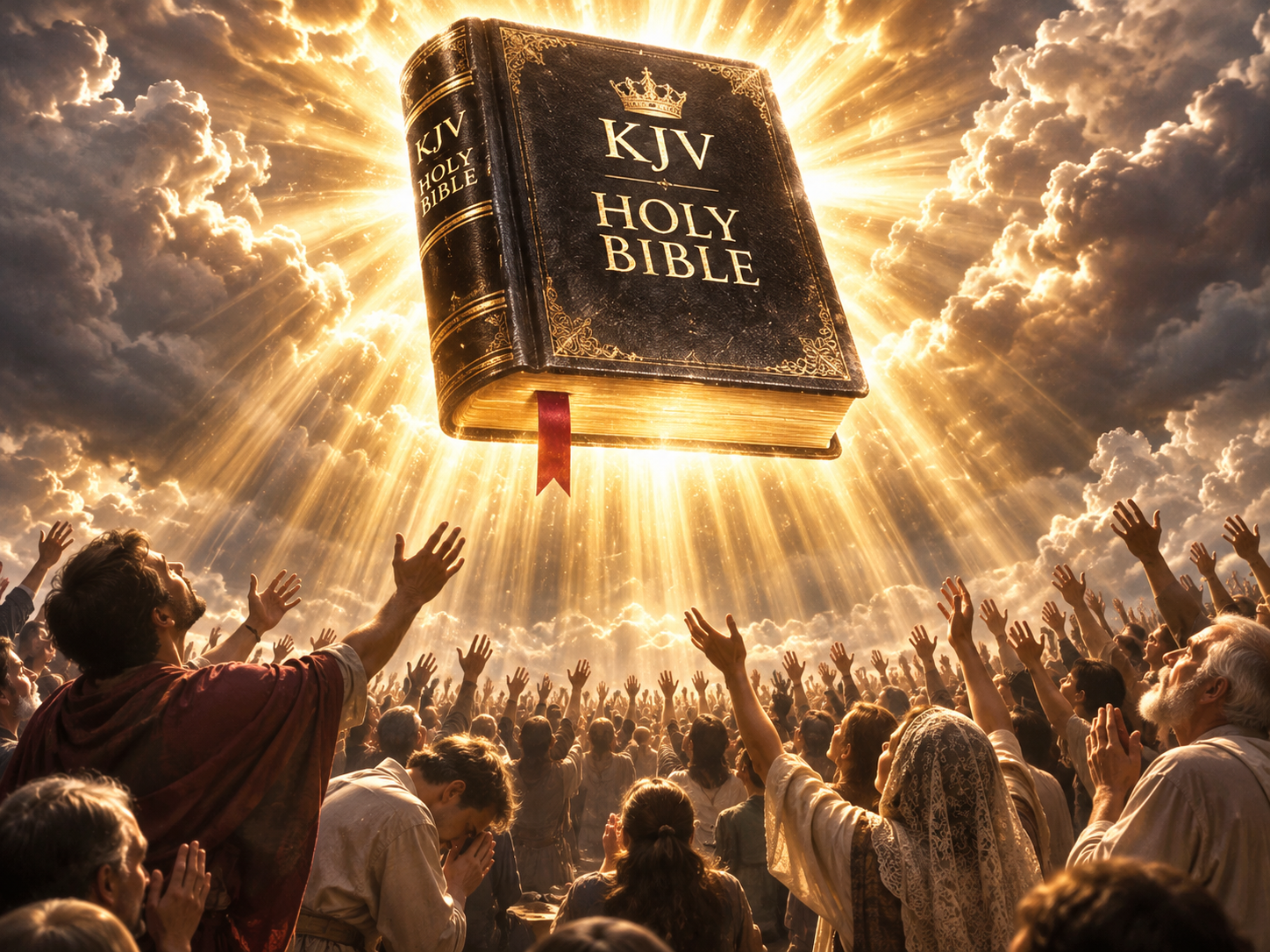
When we exchange the living God for the written witness, we eventually make ourselves the authority over what that witness is permitted to say.
In Part I: The Subtle Exchange, I explored the subtle replacement of communion with Father, Son, and Holy Spirit with a religious system centered on the Bible, the sermon, and the pastor. But there is another exchange that follows the first, and I believe its implications are even more disturbing.
When we elevate the Bible to equivalence with God, we have not elevated Scripture. We have reduced God and become His master.
We have taken the eternal, infinite, living Creator of all things and confined Him to a library of writings. The God who spoke creation into existence, who became flesh and dwelt among us, who sent His Spirit to dwell within us, has somehow become functionally equivalent to a collection of written documents. Once we’ve made that exchange, something else happens. We become the interpreters of our newly manufactured god. Eventually, the interpreter becomes the authority over the very god he created.
When the Witness Becomes the Idol
Don’t misunderstand me. I believe Scripture is inspired, authoritative, and profitable for doctrine, correction, and instruction. But I do not believe Scripture is God, and I certainly don’t believe God can be reduced to Scripture.
John begins his Gospel with a declaration that ought to settle the distinction: “In the beginning was the Word, and the Word was with God, and the Word was God” (John 1:1). Then he tells us, “And the Word was made flesh, and dwelt among us” (John 1:14). Notice what John did not say. He did not say the Word became a book, a library, or a collection of manuscripts. The Word became flesh. Jesus Christ is the living Word of God. Scripture bears witness to Him. These are not interchangeable categories.
Jesus confronted this very confusion when He told the religious leaders, “Search the scriptures; for in them ye think ye have eternal life: and they are they which testify of me. And ye will not come to me, that ye might have life” (John 5:39–40). These were people who possessed the Scriptures, studied them, defended them, and believed that within them they possessed eternal life. Yet standing directly in front of them was the One to whom those Scriptures testified. They knew the writings but failed to recognize the Author of life.
Their problem wasn’t that they valued Scripture too highly. Their problem was that they had confused the witness with the One being witnessed. And when we take that which testifies about God and elevate it to the position of God, we have created an idol. Not because Scripture is false or unimportant, but because we have assigned to Scripture an identity that belongs exclusively to Father, Son, and Holy Spirit.
When the Interpreter Becomes God
This is where the exchange becomes particularly dangerous. Unlike an idol carved from wood or cast from gold, our newly manufactured idol speaks through words. Words require interpretation, and somebody must decide what those words mean.
The Protestant Reformation gave us the principle commonly called Sola Scriptura: Scripture alone as the final infallible rule of faith. Properly understood, this principle does not make the Bible a fourth member of the Trinity or the individual interpreter infallible. But consider what happens when we combine that principle with the earlier exchange, elevating Scripture into functional equivalence with God.
First, we declare that the Bible is our final authority. Then, we declare the Bible to be functionally equivalent to Jesus. But the Bible does not walk into the room and explain itself. It must be read, translated, interpreted, and applied. Suddenly, the question is no longer simply, “What has God said?” The question becomes, “Who gets to decide what God meant?”
The pastor? The denomination? The theologian? Me? You?
Notice the transformation. We began by insisting that God was our ultimate authority. We reduced that authority to a collection of writings, then made ourselves responsible for determining what those writings mean. Finally, we began treating our interpretations as though they carried the authority of God Himself, and according to some, worthy of worship.
At that point, we haven’t merely created an idol. We’ve placed ourselves above it.
I can already hear the objections. “I’m not placing myself above God! I’m submitting to the authority of Scripture!”
Really? And by whose interpretation thereof?
Consider how often we hear someone declare, “The Bible clearly says…” Sometimes it does. But sometimes what follows is a conclusion derived from a particular translation, interpretive tradition, or theological framework. And when someone disagrees, they’re accused of rejecting Scripture, rejecting truth, or rejecting God.
Disagreement with my interpretation becomes disagreement with God.
Thus, my doctrine becomes the boundary of your acceptability, and my theological system becomes the measure of your relationship with the Creator.
We have taken the infinite God, reduced Him to a finite library, elevated that library into an idol worthy of worship, and appointed ourselves its authorized interpreters. We become the functional gods of the god we’ve manufactured. Not because we consciously believe ourselves divine, but because our interpretation has become the final authority over what our constructed god (the Bible) is permitted to say.
But Jesus Promised Us Something Else
Here’s where I believe we’ve missed something extraordinarily important. Jesus did not tell His disciples that He would leave them a theological system through which they would ultimately know God. He promised them the Holy Spirit.
“But the Comforter, which is the Holy Ghost, whom the Father will send in my name, he shall teach you all things, and bring all things to your remembrance, whatsoever I have said unto you.”
John 14:26, KJV
“He shall teach you all things.”
Jesus was speaking directly to His disciples, promising that the Holy Spirit would teach them and bring His words to their remembrance. But this promise is part of a larger revelation concerning the Spirit’s continuing ministry. Jesus also declared, “Howbeit when he, the Spirit of truth, is come, he will guide you into all truth” (John 16:13). And Paul wrote, “For as many as are led by the Spirit of God, they are the sons of God” (Romans 8:14).
Led by the Spirit. Taught by the Spirit. Guided into truth by the Spirit.
Not merely informed by a text, instructed by a pastor, or aligned with a doctrinal statement or systematic theology. We were promised the presence of God Himself, dwelling within us, teaching us, guiding us, and transforming us.
How our System Differs
Yet in much of modern, western Christianity, we’ve constructed a system in which the Holy Spirit has become functionally unnecessary. We acknowledge Him in our creeds, mention Him in our prayers, and affirm that He inspired Scripture. But when it comes to actually knowing God, we frequently substitute theological intellectualism for spiritual communion. We study what God said while neglecting the One who gave us His Spirit. We learn about God and confuse that knowledge with knowing Him. We live our lives forcing our behaviors to produce spiritual fruit.
When was the last time you saw an apple tree wrap itself with a bow to remind itself to bear fruit in the summer?
I’m not suggesting that the Spirit contradicts Scripture or that every feeling and personal conviction comes from God. Discernment matters. Scripture matters. Sound doctrine matters. But none of these was ever intended to replace communion with the living God.
The Holy Spirit was not given merely to help us understand a book. He was given to bring us into communion with God and transform the way we live.
When the Fire Tests What We’ve Built
There’s another distinction we’ve largely missed. We have become so preoccupied with what we believe about God that we’ve confused intellectual understanding with spiritual maturity. We measure faithfulness by doctrinal agreement, biblical knowledge, denominational affiliation, and our ability to defend theological positions. But is that how God measures what we’ve built?
Paul writes:
“Now if any man build upon this foundation gold, silver, precious stones, wood, hay, stubble; Every man’s work shall be made manifest: for the day shall declare it, because it shall be revealed by fire; and the fire shall try every man’s work of what sort it is.”
1 Corinthians 3:12–13, KJV
“Of what sort it is.”
Not how impressive it appeared. Not how sophisticated the theology was. Not how effectively we defended our doctrines or persuaded others to agree with us. The fire will reveal the quality of what was built. Paul is speaking particularly about building up God’s church, but the principle raises a question that ought to challenge every one of us: Are we building upon Christ, or are we constructing religious monuments to our own understanding of Him?
And notice what Paul establishes immediately before this passage:
“For other foundation can no man lay than that is laid, which is Jesus Christ.”
1 Corinthians 3:11, KJV
The foundation is not our denomination. It is not our doctrinal confession, our theological system, or our interpretation of Scripture.
The foundation is Jesus Christ.
Paul makes another remarkable distinction in 1 Corinthians 8:1–3: “Knowledge puffeth up, but charity edifieth.” He continues, “And if any man think that he knoweth any thing, he knoweth nothing yet as he ought to know. But if any man love God, the same is known of him.”
Think about that. Knowledge can produce pride. Love builds up. And the ultimate significance is not merely what we know about God, but that we love Him and are known by Him.
Jesus offered an equally sobering warning in Matthew 7:22–23. He described people who would approach Him claiming to have prophesied, cast out demons, and performed mighty works in His name. Yet His response would be, “I never knew you: depart from me, ye that work iniquity.”
Not “You misunderstood eschatology.” Not “You attended the wrong denomination.” Not “Your systematic theology was deficient.”
“I never knew you.”
That’s a statement about relationship, communion, and life.
We will not stand before God to demonstrate how successfully we mastered the intellectual contents of Scripture. Our theological knowledge will not substitute for knowing Him, and religious performance will not establish a relationship that never existed. What we have built, including what we built in His name, will be exposed for what it actually is.
This isn’t salvation by works. Paul reminds us that salvation is by grace through faith, not something we earn through religious performance (Ephesians 2:8–9). Yet he immediately tells us that we were created in Christ Jesus unto good works (Ephesians 2:10). Our works do not purchase our relationship with God. They are meant to reflect the transformation that proceeds from it.
Jesus defined eternal life in strikingly relational terms: “And this is life eternal, that they might know thee the only true God, and Jesus Christ, whom thou hast sent” (John 17:3).
That they might know thee.
There’s an enormous difference between knowing about someone and knowing them. I can study everything ever written about my wife, memorize her words, catalog her preferences, and develop an extraordinarily accurate intellectual understanding of who she is. But none of that constitutes a marriage. I can know everything about her and still fail to love her, listen to her, protect her heart, or share my life with her.
Our relationship with God is no different. The Scriptures introduce us to Him, reveal His character, and provide instruction and correction. But they were never intended to become a substitute for knowing Him. The Holy Spirit was sent to dwell within us, to lead us into truth, and to transform our hearts and lives.
Where Legalism Finds Its Throne
Once we’ve confused knowing Scripture with knowing God, and our interpretation of Scripture with the authority of God, legalism finds fertile ground. We begin constructing systems to measure faithfulness according to our interpretations. We establish rules, boundaries, expectations, and standards of acceptability. Every rule can have a verse. Every condemnation can have a proof text. Every demand for conformity can be defended as obedience.
Before long, we’ve replaced the transformative work of the Holy Spirit with religious compliance. Instead of encouraging people to know God, we teach them to conform to our understanding of Him. Instead of helping them discern the Spirit’s leading, we demand submission to our theological conclusions. Instead of examining the fruit of a life transformed by love, we measure adherence to the systems we’ve constructed.
Jesus confronted this very problem when He told the religious leaders, “For laying aside the commandment of God, ye hold the tradition of men” (Mark 7:8). Their traditions had become so authoritative that they could effectively nullify God’s commandments. The system had become the master, and its interpreters had become the gatekeepers of God.
And here’s the irony. We often defend this entire process as humility. “We don’t follow men. We follow the Bible.”
Except we do follow men: we follow translators, commentators, theological traditions, denominational interpretations, and perhaps most significantly, ourselves. The problem isn’t that interpretation exists. Interpretation is necessary. The problem begins when we refuse to acknowledge that our interpretation is precisely that, an interpretation, and elevate it to divine authority.
That isn’t humility. That’s a remarkably sophisticated form of religious self-exaltation. It’s where we have become the god of our object worship.
The Witness Was Never Meant to Become the Throne
Let me be clear. I’m not arguing that Scripture should be discarded, that doctrine is irrelevant, or that spiritual experiences should be accepted without discernment. I’m arguing that we’ve confused categories, and those confused categories have fundamentally distorted how we understand our relationship with God.
Scripture is inspired testimony. Jesus Christ is the eternal Logos. The Holy Spirit is a divine Person, not an interpretive methodology or a bit of wax seal on the container called salvation. The Father is not confined to the boundaries of a canon. And none of them are subordinate to my ability to understand a passage of Scripture.
God did not call us merely to become proficient students of religious literature. He called us into communion with Himself. He gave us His Son, promised us His Spirit, and invited us into a relationship that transforms not merely what we know, but who we are and how we live.
The first subtle exchange happens when we mistake the witness for God. The second happens when we mistake our interpretation of that witness for the voice of God. And the final tragedy is that, having constructed a god within the boundaries of our own understanding, we appoint ourselves the authorities over everyone else’s relationship with Him.
We may spend our entire lives defending the religious structures we’ve built, convinced that their sophistication demonstrates our faithfulness to God. But when the fire comes, it will not test how confidently we defended those structures. It will reveal what they were made of. And no amount of theological certainty can turn wood, hay, and stubble into gold.
The question is not merely whether we understood the Scriptures correctly, but whether those Scriptures led us to the living Christ, whether we allowed His Spirit to transform us, and whether our lives bear the fruit of knowing Him.
We began by claiming to worship God alone. We reduced Him to a library, made an idol of the witness, and enthroned ourselves as its interpreters and gods.
And we’ve managed in the end, to call it biblical faithfulness.

