How Jesus Heals Depression

Depression sucks.  It really does.  I’m one of those people that believes the average never-been-depressed-person doesn’t have a clue as to what real depression is actually like.  So I’m going to peel back some of the layers and let you have a peek.  If you want to understand, then turn on your empathizer, because otherwise, you’ll have a difficult time getting close to understanding.

Please know that I’m not suggesting people don’t care, or don’t want to understand – but for the average non-depressed person, it’s like asking men to empathize with childbirth.  As men, we can live through it with our wives, but we have no clue what-so-ever what it’s actually like.

Outline

In this blog, I’m going to provide some definitions that help people understand what depression is and what it is not.  I’m going to reveal the root causes of depression and touch on some practical steps you can take to eliminate those roots.

Finally, I will explain how to engage with Jesus to allow Him to heal your emotional wounds.  In a future blog, I’ll discuss the authority, or perhaps the justification, for this healing.

What Depression is Not

Depression is not a minor discouragement, nor is it a hardship to be endured. Depression is not caused by the obfuscation of Jesus, our hope. Depression does not arrive because you didn’t get what you wanted or because something unpleasant happened, and you’re now sad.

A depressed person may not readily show you their innermost condition.  They may interact seemingly well in your presence or appear well adjusted.  They can hold jobs, function well in society, and participate in activities.  You’ll never know that internally, they’re on the brink of despondency.  You’ll never know that their aversion to drugs and weaponry is just a cover to keeping themselves safe from self-harm.

A Proper Definition

Years ago, I went to a physician, our Family M.D.  I told him I was depressed.  He asked how I felt. I told him I was despondent. He replied, “well, that’s a pretty strong word, don’t you think?”  I’m not kidding. Apparently, I wasn’t permitted to feel despondent in his worldview of depression.

Despondency

Despondency is defined as a state of feeling profound hopelessness, dejection, discouragement, and gloom. People who are very depressed are despondent: they are in such a condition that every fiber of their being hurts; they live with an aching headache every day; they generally find relief only when sleeping and they look forward to the morning when their head isn’t aching, and their soul isn’t breaking.

Some of these may have suicidal ideations.  The strong ones never go down that path – they somehow learn to live with the pain or find a way out.  The less fortunate succumb to the battle, opting for the ultimate, permanent solution.

Hopelessness

Helplessness is a big part of depression.  People with no hope are unable to see past their current state.  They cannot imagine a life any better than what they’re currently experiencing – even when Jesus plays a significant role in their life.  In their world, there is nothing that can pull them out of the pain, out of the pressure or away from their circumstances.  Their state of being is such that they cannot move towards a better state – they can’t even grasp onto a rope of change dangled in their midst.

Discouragement

In order to understand discouragement, let’s define encouragement and take the inverse.

Encouragement is a form of joy.  It is derived from the knowledge or expectation that something unappealing will be reversed, or turned to good in some way.  Encouragement enables determination and confidence, which breeds hopefulness.  Encouragement helps lay a foundation to build a path to better outcomes.

Discouragement is the opposite of all of that.  The depressed person can see nothing that is appealing in their future, they believe no good is likely to happen.  They see nothing that can move them from their position of pain to a better place, they have no hope for their future.  The longer they stay depressed, the less likely they are to do something – anything – to help themselves out of the miry clay in which they’re stuck.

Dejection

Dejection is that state of being in which we feel alienated from those around us as if we’re somehow less than they are, less capable, less worthy, more broken.

Gloom

Gloom generally colors the world in which the depressed person lives.  Almost all things in the depressed person’s world are tainted with one or more of the qualities I’ve described.  If you were to assign a color to the world of a depressed person, it would be grey.  No shadows, no definition – just a muddled life without clarity or useful form.

The Root Cause

A person much more learned than myself, a therapist who held a Ph.D. in psychology, told me that the root causes of depression were unresolved fear, anger, and loss.  When she suggested that I was perhaps the angriest person she had ever met, I vehemently dismissed her assessment.  But it was something I couldn’t let go of.  As I wrestled with her evaluation, I discovered that she was right: I had a lot of unresolved pain that was surfacing as anger.  And, as most of us know, many times, depression is simply anger turned inward.

Escaping Depression

I’m completely and utterly free of the bondage of depression, and I have been for many years. I believe that there are people whom Jesus has completely healed of depression in one fell swoop. And others like me have traveled a road of discovery. Since I’ve learned how to address depression when it tries to creep up the walls of my prosperity (3 John 1:2-3), I will enumerate for you the tools I’ve learned to use to address the problem.

Knowing the Truth

The first thing provided to me by God was John 8:32: “ye shall know the truth, and the truth shall set you free” (John 8:32).  Recall that my Ph.D. therapist suggested that the root cause of depression is unresolved anger, unresolved loss, and unresolved fear.  Your first job is to acknowledge your held anger and fears.  You must admit your losses and face them.  The bottom line is that you must want to change.  Perhaps you’re like the father who cried, “help my unbelief.”  You may need to cry out, “help me to want to change...”

Trust in the Lord

I almost don’t want to go here, only because some people believe just seeing the “preciousness of Jesus” will make the clouds of depression float away.  I don’t have much respect for that philosophy, nor their pundits.  Depression is not about the absence of comprehension of how precious Jesus, God, or Holy Spirit is to any given person.  It’s far more complex.

The root cause of depression, aside from some physical ailment, is entirely about your belief systems.

As someone who lived with depression from a very, very young age and then well into adulthood, I will assert you need to understand this: God has a mental health plan, and He has an account with your name on it.  He’s ready for you to go to Dr. Jesus and receive some services.

And as I suggested in previous blogs, depression is all about what you’re focused on, what you believe, and what you give power to.

Resisting the Devil

For though we walk in the flesh, we do not war according to the flesh, for the weapons of our warfare are not of the flesh, but divinely powerful for the destruction of fortresses. We are destroying speculations and every lofty thing raised up against the knowledge of God, and we are taking every thought captive to the obedience of Christ, and we are ready to punish all disobedience, whenever your obedience is complete.  (2 Cor 10:3-6)

The battle for victory over depression is waged in our mind (through choice) and in our spirit, through the finished work of Jesus.  Through divinely powerful weapons enabled through Holy, creative imaginations, we destroy fortresses established in our thinking patterns: we destroy speculations, and every lofty thing raised up against the knowledge of God; we take all thoughts captive to the obedience of Christ.

You will know the truth and the truth will set you free (John 8:32), doesn’t mean you acknowledge fears, loss, and anger as active entities that affect you, it means you understand where they come from, you recognize the lies of the devil that enable their fortresses to have power over you.

The Steadfast Mind

There is one verse in scripture that clearly lays down where our depression has its roots, and how to overcome its debilitating effects over us.  Some people will not like this scripture because it’s too easy; perhaps it seems to make light of the issues at hand.

For a genuinely despondent person, I understand entirely.  Been there, done that.

But if you will find and obliterate your fear through His strength, if you will use this scripture in conjunction with destroying strongholds, you will overcome depression:

The steadfast of mind You will keep in perfect peace, because he trusts in You.  (Isa 26:3)

This steadfast mind is focused on the provision God has already provided for you.  It activates faith in His goodness and provision for you.

Emotional Healing for Depression and Emotional Wounds

I learned some of this technique by myself years ago, and what I learned was later augmented by someone else who understands emotional healing, Praying Medic.  This process he discovered, is outlined below.

Emotional healing is an extremely powerful and functional practice – not because the formula is powerful in itself, but because of who is doing the work: Jesus.  You will find that for some of the things you take to Jesus in the process, the wounds will be so completely healed, that you may forget what it was that Jesus healed – your sins removed as far as the east is from the west (Psalms 103:12)

Trigger Alert

In this process, you will identify a situation that, when you recall it, will bring to the surface a negative emotion.  The point of this process is to trigger the negative emotion so that Jesus can heal it.  Therefore, I recommend you start with something manageable.

This is a Process

It is highly likely that you will find this to be a process that removes layers of protection you’ve built up over the years – like an onion of despair.   Once you’ve progressed through one phase, pause and rest for a moment before you begin again.

The Emotional Healing Process

Speak these things aloud. Recall that whenever Jesus performed healing, He spoke aloud against the infirmity.

Have faith in God.  Amen, I say to you, whoever says to this mountain, ‘Be lifted up and thrown into the sea,’ and does not doubt in his heart but believes that what he says will happen, it shall be done for him (Mark 11:22-23)

  1. Identify a painful emotion associated with a particular event.
    •  If the emotion is sinful, ask God to forgive you and receive his forgiveness.  It is good to remind yourself of forgiveness principles, such as 1 John 1:9
    • Say that you believe His blood has taken away the penalty and consequences of your sin.
    •  If it is not sinful, go to the next step.
  2. Tell Jesus you want the emotion removed from your soul.
  3. Ask Jesus to heal the wound in your soul caused by the emotion.
  4. Tell Jesus you receive His healing.
    • If the emotion is there because you believed a lie about that situation, ask Jesus to show you the truth about the situation.
  5. An optional step is to ask Jesus to give you something positive to replace the negative emotion that He is removing.
    • If you ask Him to take away sadness, you might ask Him to give you joy.
    • If you ask Him to take away anger, you might ask Him to give you peace.
  6. Rest for a moment, ask for His presence to come and rest in Him.
  7. Recall the situation that caused the painful emotion.
    • If there is a new negative emotion, begin again at Step 1.

Example

When I was very young, I was molested/assaulted by an older man.  After my memory of the event resurfaced, my emotional healing process progressed something like this:

  • Jesus, I feel anger towards that person.  I don’t want to feel this anger anymore.  Please take this anger from me, and heal the wound in my soul; I receive your healing.  Please give me peace in place of this anger.

Once I was done with this process, I paused for a moment and then recalled the event.  I observed that I then felt a different emotion and went through the process again.  After several iterations (I don’t remember how many, or the emotions other than anger), I was completely healed of assault against me.  It’s now like a distant memory to me, as if it were something written about me, not something that happened to me.

I should also mention that before I learned this emotional healing process, I had thoroughly used Neil Anderson’s Victory Over Darkness and Bondage Breaker.  These are excellent books and thoroughly instruct and guide you on how to forgive and reconcile.  My opinion is that these books help you immensely, but they don’t always result in helping you heal the resulting wounds.


A Disclaimer

I would like for you to understand that I am in no way associated with the medical or physiological profession.

I do not claim to treat or diagnose any disease or illness, neither do I offer the information included in this blog as a substitute for medical advice or treatment. My ideas and expressions thereof are for personal consideration and evaluation only.

I also do not take responsibility for any individual’s disease or illness nor am I responsible for their healing. I offer no guarantee that anyone will be healed or that any disease or illness will be prevented.

I do, however, believe that we are spiritual beings who have a soul and live in a body according to 1 Thessalonians 5:23.  I also believe that most problems that manifest in the soul and body have a spiritual root. 

But most importantly, I believe that Jesus paid the price for our healing (Isaiah 53:4-5, 1 Peter 2:24; 1 Corinthians 1:18; Revelation 12:11) and it is by only the power of God, through the blood of Jesus\’s cross, that we have provision, prosperity, and victory over anything that opposes us or affects us.

I believe God heals today because He is the same yesterday, today, and tomorrow.

Understanding Your Actions

It’s strange how that’s all twisted around, no? As if our actions are not governed by our beliefs.  But why should we be surprised?  Have our churches not authoritatively taught us from the word of God that we’re “just sinners saved by grace?”  

Have these same people never read

Do not eat the bread of a selfish man, or desire his delicacies; for as he thinks within himself, so he is.  He says to you, “Eat and drink!”  But his heart is not with you. You will vomit up the morsel you have eaten, and waste your compliments. (Prov. 23:6-8)

Maybe that\’s just too deep for the average pastoral teacher; for perhaps when Jesus said,

Beware of the leaven of the Pharisees, which is hypocrisy.  Nothing is covered up that will not be revealed, or hidden that will not be known. Therefore whatever you have said in the dark shall be heard in the light, and what you have whispered in private rooms shall be proclaimed on the housetops (Luke 12:1-3) …

such people didn’t make the bread and leaven connection?  Do they not understand that it is not God waiting for the right opportunity to expose our sin, but it is our actions driven by our belief systems that will be heard in the light and proclaimed on the housetops?

A belief may indeed be reflective of a reasonably valid conviction and perhaps even truth, but a belief or conviction that does not govern your behavior is one of the purest examples of hypocrisy: it is a fantasy only to be trotted out when necessary to persuade others of a moral fortitude. 

If you want to understand your belief systems, if you want to know what is at the core of your being, then look at your behaviors, and look at your thought patterns, look at the private sins you confess that no one knows about, look at the disparaging remarks you make of others whom you disagree with – especially those done in jest.  Delve into those things and you will find the lies you confer as truth (John 8:34-38).

In other words, if your actions smell of evil, it’s because your belief systems do too.


Convincing Your Friends Otherwise

I\’ve tried. I\’ve talked. I\’ve prayed. I\’ve debated. I\’ve used carefully constructed logical arguments, all based on scripture. But to no avail.

Some of my friends are still Cessationists, Dispensationalists, non-believers or what-evers. So what gives? How do you convince someone of an alternative understanding – one you\’ve worked through and are certain is the truth?

You don\’t. And I would suggest that you take that to heart. If not for any other reason, because Paul didn\’t win souls or change hearts through a debate.  And if that\’s not enough, then you\’ve got to accept the fact that God has got this one. He\’s a big boy and can handle the situation.

I was with you in weakness and in fear and in much trembling, and my message and my preaching were not in persuasive words of wisdom, but in demonstration of the Spirit and of power, so that your faith would not rest on the wisdom of men, but on the power of God. (1 Cor. 2:3-5)

Remember that faith comes from hearing, and hearing from the word of God (Rom. 10:17).  And before you go down the wrong path, don\’t even begin to think that going to church and hearing a sermon, or even better – reading scripture – is hearing the word of God: because it\’s not.

Faith – Yielding and Experience

The next problem you have to tackle is that faith rests upon two things: yielding, and experience.  Ya, it does.  When it rests upon these things, it becomes the foundation of a testimony: faith is the evidence of things not seen (Heb. 11:1).  Evidence is derived from an experience, and only from an experience can a testimony be given.

Any serious scriptural study of faith will reveal that faith is founded upon the confluence of two things: belief and trust.  Belief is reasoned, and trust is gained through interaction or experience.  I may easily believe that you can mow my lawn because you have a lawnmower and you\’ve said you\’ll do the job.  But I may not trust that you will mow my lawn because you never have done so when you\’ve said you would in the past.

Contrarywise, I may trust your word about mowing my lawn because you have always been trustworthy in the past, but I will doubt your ability to do so because you do not own a lawnmower.  In both instances, I lack faith in your ability to follow through and actually mow my lawn.  This is an example of what I call \”natural faith.\”

Hence, one has an experience with God, reasons through the word God has given, and because of those two things working together, one can yield to God in faith when the next mountain presents itself.  Catch that bit about yielding: faith is not conjured up, it is not an intellectual effort, it is a heart effort:

But to this day whenever Moses is read, a veil lies over their heart; but whenever a person turns to the Lord, the veil is taken away. (2 Cor. 3:16)

 The word \”turns\” means to revert back, to return – to yield.

And the Point?

The point is this: we must learn to function in society as Jesus functioned in His society.  People need an experience with God, they need a spoken word (logos, an idea) that prunes their heart:

... every branch that bears fruit, He prunes it so that it may bear more fruit.  You are already clean {pruned} because of the word which I have spoken to you …  If you abide in Me, and My words abide in you, ask whatever you wish, and it will be done for you. My Father is glorified by this, that you bear much fruit, and so prove to be My disciples. (John 15:2-8)

Just as Moses experienced the burning bush and turned (Exo. 3:3) and then God spoke, so people need an experience with God, a spoken word from Jesus that prunes them.  Paul described this same truth to the Corinthians in the idea around prophecy:

But if all prophesy, and an unbeliever or an ungifted man enters, he is convicted by all, he is called to account by all; the secrets of his heart are disclosed; and so he will fall on his face and worship God, declaring that God is certainly among you. (1 Cor. 14:24-25)

So then: when one has actually heard in their heart the spoken word of God (Rom. 10:17) one is pruned, or cleansed (John 15:2-8).  Thus prophecy (1 Cor. 14:24-25) is a medium that enables one to hear God\’s word in their heart resulting in cleansing (pruning).

Therefore, in the end, we need to learn how to walk in this truth:

These signs will accompany those who have believed: in My name they will cast out demons, they will speak with new tongues; they will pick up serpents, and if they drink any deadly poison, it will not hurt them; they will lay hands on the sick, and they will recover. (Mark 16:17-18)

The point is not to logically convince anyone of the truth – because none of us have the whole truth (amazingly, God is cool with that).  Your job is to bring people into relationship with God, with the Son Jesus.  And for those who already have a relationship, your job is to plant seed or to water the seed already there, because it is God who causes the growth (1 Cor. 3:7)  Who here knows that in order to make vines grow well and produce fruit, they must be pruned?

A Better Way

If Paul refused apologetics as a viable tool to win souls, then perhaps we should too.  Once a person has received a personal touch from God, they then must deal with that experience.  They either must reject the experience – and reject God too – or accept what has happened to them and yield to Jesus.

Do the Commandments

The typical mainstream denominational church doesn\’t have a clue how to make a disciple. Jesus never said, \”teaching them to learn the doctrines I have taught you,\” – which is the best such a church has ever done.

The typical church first makes one into a non-empirical learner (lacking experience), then they teach them how to pass a written driving exam. 
As good a learner, you can eloquently pontificate about what you\’re supposed to do while driving a car, and even pretend you\’re doing it.
But what you\’re lacking is experience: you\’ve never been taught how to obey or perform the commandments of driving a real car – you\’ve never sat behind a wheel and turned it on, let alone driven it down a street. You can\’t accelerate, park, stop, change gears, or safely navigate through a dangerous intersection or situation.
\”… teaching them to observe all that I have commanded you.\”

If you want to follow the great commission, if you want to be a disciple, go first to the commandments of things to do: Matt. 10, Mark 6, Luke 9 – and then keep them as they are, attending to and doing the commandments as the disciples of the Jesus would have understood within the context of their life experience with Jesus.

Breaking Your Jesus Paradigm

It\’s Wabbit Season!  It\’s Duck Season!

Pastors have taught a simple understanding of Jesus for hundreds of years – perhaps even thousands of years. That simple understanding is this:

Jesus was able to perform miracles because He was God incarnate, and as being such, He retained the power and authority of God which enabled Him to perform miracles (healings, etc.).

They further complicate this doctrine by suggesting that Jesus performed miracles in order to authenticate, or prove who He was.

But is this true? 

#1 – Jesus gave up His rights to power and authority

Have this attitude in yourselves which was also in Christ Jesus, who, although He existed in the form of God, did not regard equality with God a thing to be grasped (retained), but emptied Himself, taking the form of a bond-servant, and being made in the likeness of men.  Being found in appearance as a man, He humbled Himself by becoming obedient to the point of death, even death on a cross. (Philp. 2:5-8)

#2 – Jesus was not empowered at His baptism but after His trial in the wilderness 

Jesus, full (Gk. plērēs) of the Holy Spirit, returned from the Jordan and was led around by the Spirit in the wilderness … And Jesus returned to Galilee in the power (Gk. dynamis) of the Spirit, and news about Him spread through all the surrounding district. (Luke 4:1, 14)

#3 – God anointed Jesus with the power of the Holy Spirit

You know of Jesus of Nazareth, how God anointed Him with the Holy Spirit and with power (Gk. dynamis), and how He went about doing good and healing all who were oppressed by the devil, for God was with Him. (Acts 10:38)

#4 – Jesus performed works by the power of the Holy Spirit

… I cast out demons by the Spirit of God … (Matt. 12:28)

#5 – Jesus did nothing of His own will or desire, but only what He saw the Father doing

Therefore Jesus answered and was saying to them, “Truly, truly, I say to you, the Son can do nothing of Himself, unless it is something He sees the Father doing; for whatever the Father does, these things the Son also does in like manner.\” (John 5:19

#6 – Jesus did not convince people of His identity through His works or Testimony

When Jesus came to the region of Caesarea Philippi, he asked his disciples, “Who do people say the Son of Man is?” They replied, “Some say John the Baptist; others say Elijah; and still others, Jeremiah or one of the prophets.” \”But what about you?” he asked. “Who do you say I am?” Simon Peter answered, “You are the Messiah, the Son of the living God.” Jesus replied, “Blessed are you, Simon son of Jonah, for this was not revealed to you by flesh and blood, but by my Father in heaven … Then he ordered his disciples not to tell anyone that he was the Messiah.\” (Matthew 16:13-20)

#7 – Jesus did not glorify Himself: God glorified Jesus, Jesus glorified God

\”If I glorify Myself, My glory is nothing; it is My Father who glorifies Me\” (John 8:54). 

\”Jesus spoke these things; and lifting up His eyes to heaven, He said, \’Father, the hour has come; glorify Your Son, that the Son may glorify You … I glorified You on the earth, having accomplished the work which You have given Me to do.\’\” (John 17:1

\”The glory which You have given Me I have given to them\”, then He says, \”so that they may see My glory which You have given Me.\” (John 17:22)

Transliteration: A Literary Tool

The most important thing to remember about any translation process is that it cannot be performed without interpretation.

This means translation always carries the opinion of the translator.

At least three different tools can be applied when translating from one language into another language, such as Greek into English.

1)  Translation
2)  Interpretation
3)  Transliteration

Translation

Translation is the process of converting a word in one language into the corresponding word in another language. Unfortunately, this rarely works perfectly as concepts and ideas are expressed by a word in a given language usually cannot be adequately expressed by a word in another language.

When I was cutting my Christian teeth in the Southern Baptist church, I was taught – with no doubt what-so-ever – the KJB was a “word for word translation.” So imagine my dismay (and embarrassment of naivety) when years later, I learned differently. I discovered that ideas, expressions, and syntax in Hebrew and Greek simply cannot be expressed word-for-word in English. So in those instances, another tool is used: interpretation.

Interpretation

Interpretation is used with translation to convey a word or sentence’s underlying ideas into their equivalent ideas in the target language. This is performed by applying various corollary ideas and constructs to express the original idea adequately. If, however, this translation and interpretation process becomes overly cumbersome, we may use another tool called transliteration.

Transliteration

Transliteration is the process of converting a word in a source language into a new word in the target language by either transposing letter-for-letter between the two languages or transposing sound-for-sound between the two languages.

In either case, a new word is created in the target language. Since a new word is constructed, the translator must provide its definition. Once defined, the term can convey the original intent and idea without re-interpretation and translation.

There are three reasons why transliteration is used:

  • When there is no useful word in the target language that conveys the same meaning 
  • When repetitive interpretation would be too cumbersome for the literary context 
  • When the translator wants to hide the actual meaning of the word.

First, whether you realize it or not, several traditional New Testament doctrines survive as you know them only because of transliteration.

Forms of Baptism

Depending upon your denominational bent, baptize either means sprinkling water upon someone, or it means immersing someone completely. But did you know that the word baptize is a transliteration, not a translation, not an interpretation?

The interpretation or definition of the Greek word “baptizō” (bap-tid’-zo) is to make something thoroughly wet. Therefore, the appropriate translation is the word immersed.  

Thus, John the Baptist was actually known as John the Immerser.  When we realize that the traditionally correct method of baptism in the western (Catholic) church was sprinkling, we understand why a transliteration was provided and why its definition was constructed and obtained outside of scripture.

Deacon

In the KJB, the word “deacon,” in its various forms, is found 5 times.  It is transliterated from “diakonos” and “diakoneō.”  

But did you also know that these two forms alone are collectively found 67 times in the New Testament? These two words are translated as follows:

  • minister
  • servant
  • to be ministered unto
  • serve
  • administer

Did you know that Paul considered himself a deacon?

What then is Apollos? And what is Paul? Servants (diakonos) through whom you believed, even as the Lord gave opportunity to each one.

1 Cor. 3:5 [NASB]

Who then is Paul, and who is Apollos, but ministers (diakonos) by whom ye believed, even as the Lord gave to every man?

1 Cor. 3:5 [KJV]

Therefore, when you see transliteration without definition, you should consider that a huge red flag for the particular version of the Bible you’re reading.

By providing the transliteration for deacon rather than the translation used elsewhere, the translators hid the word’s meaning to support an organizational structure within a state-sanctioned and controlled institution. Substantially, they helped propitiate the office of the deacon where none existed.

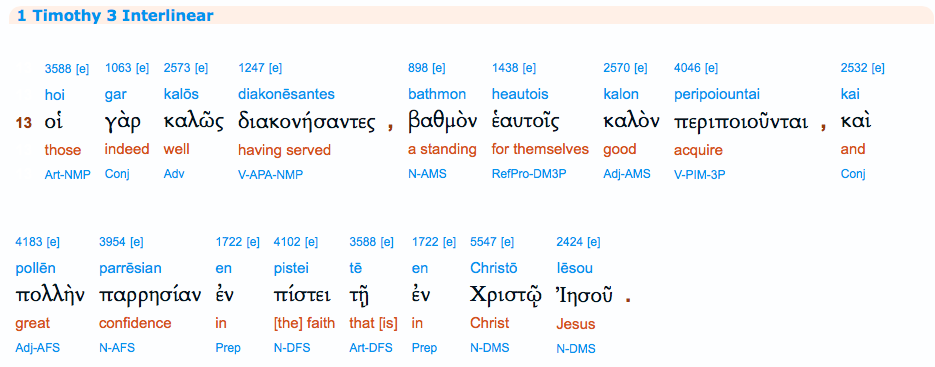
But one might rightfully ask, what about 1 Timothy 3:13? 

For they that have used the office of a deacon well purchase to themselves a good degree, and great boldness in the faith which is in Christ Jesus.

If you consider the interlinear version of that passage, you will hardly recognize it. Word-for-word, it reads as follows [words added for clarity]:

those indeed well having served a standing for themselves good acquire and great confidence in [the] faith that [is] in Christ Jesus.

The KJV translators took such liberty with this section of scripture that the Greek word for office (praxis) – which means” a practice, deed or work” – is not even found in this section (https://biblehub.com/interlinear/1_timothy/3.htm)

The point then is this: do not take translation works at face value. Instead, dig in and discover what is actually there or not there for yourself.

Further Study

Other words you might find interesting to study:

Apostle

Using the surrounding context of scripture, discover how many apostles are mentioned or referred to in the New Testament.

Angel

How has our doctrine of angels been influenced and/or established by transliteration?

An Eternal Mindset

Of all the parables of Jesus, these are two of which I find most pungent for the believer:

Both of these parables address our personal calling, specifically given to us by God.  This calling, this assignment, is our race.   Finding our calling, running our race, enables us to finish well and receive a full reward, \”the prize\” as it\’s called by Paul.

The Parables

In both parables, a nobleman leaves to go on a journey.  But before doing so, he calls his slaves and entrusts various assets to them.  In the parable of the minas, each one receives an identical investment.  In the parable of the talents, each one receives an investment tailored to their abilities.  And in both scenarios, the slaves all increase their investments except one who asserts the fear of his master and, because of that fear, does nothing with the investment.  In essence, the excuse is that the master would take from the slave what he had worked to produce – so what\’s the point of working at all?  \”Here, you have what is yours,\” is the paraphrased response.

The typical doctrine of these parables suggests that you\’ve been given talent or ability, so make sure you use it for God.  Otherwise, you\’re wasting the gifts He has given you.  While at a superficial level that is not an inaccurate description, there is a larger context involving \”The Race,\” \”The Judgement Seat of Christ,\” and the \”Full Reward.\”

Our Race To Win or Lose

In a race, you\’re supposed to start at the beginning, run the assigned course and declare a winner.  In a foot race, not everyone wins.  But in God\’s economy, we\’re not in competition with others, but ourselves.

Therefore, it\’s possible to run the race but fail to receive a reward.  Because although we may have started well, we can get off course by choosing our own way or creating our own path instead of following the course designed for us.

We can run until we collapse, but unless we begin at a proper starting line and run the course laid out by the Course Master, we will end up in the woods or on some deserted road: exhausted, dehydrated and perhaps close to death, hoping someone will help us find our way back to where we should be.

Paul admonished the Galatians to get back into the race: \”you were running well; who hindered you from obeying the truth?\” (Gal 5:7). This reflects Pauls\’ admonition to the Corinthians when he said, \”do you not know that those who run in a race all run, but only one receives the prize? Run in such a way that you may win\” (1 Cor 9:24).  John had a similar admonition when he said, \”watch yourselves, that you do not lose what we have accomplished, but that you may receive a full reward\” (2 John 1:8).

Furthermore, we are not designed to run a race that exasperates us (Eph. 6:4) – anger, frustration, failure: those are not the course we have been given by a good father. While there will be such things and seasons in our life (2 Cor 4:8-12), we are designed to be more than conquers; we are designed to stay in the race given to us and to finish well.
What we see then, in these encouragements of Paul and John, are those things spoken by Jesus in the parables.  Some of the slaves received a full reward, while others received no reward and suffered loss.  This dovetails precisely into the Judgement Seat of Christ.

The Judgment Seat of Christ

At this judgment, Christ is seen as our judge.  We will be evaluated for our works (e.g., our works of the flesh or of Faith –James 2:14-26).  However, we will not be judged for our sins, since Jesus has been judged for us (2 Cor 5:21).  If we are to be judged for our sins, then the work of Jesus was incomplete and it is therefore not by grace through faith by which we are saved (Eph 2:8-11).   The implication, therefore, is this: at the Judgement Seat of Christ, we can
  1. Receive a full reward
  2. Receive a partial reward
  3. Receive no reward
  4. Suffer loss
  • For we must all appear before the judgment seat of Christ, so that each one may be recompensed for his deeds in the body, according to what he has done, whether good or bad (2 Corinthians 5:10).
  • For no man can lay a foundation other than the one which is laid, which is Jesus Christ. Now if any man builds on the foundation with gold, silver, precious stones, wood, hay, straw, each man’s work will become evident; for the day will show it because it is to be revealed with fire, and the fire itself will test the quality of each man’s work. If any man’s work which he has built on it remains, he will receive a reward. If any man’s work is burned up, he will suffer loss; but he himself will be saved, yet so as through fire (1 Cor 3:11-15).
  • \”But I tell you that every careless word that people speak, they shall give an accounting for it in the day of judgment. \”For by your words you will be justified, and by your words, you will be condemned.\” (Matt 12:36-37)
  • \”He who rejects Me and does not receive My sayings has one who judges him; the word I spoke is what will judge him at the last day (John 12:48)

The point then is to live – to run your race – in such a way that you receive a reward.  

James suggested that this life we live is but a vapor.  But it is this life in which we earn our eternal reward.  How you live it up to you.  What you do with your calling, and how you work it out, is up to you:
  • Come now, you who say, “Today or tomorrow we will go to such and such a city, and spend a year there and engage in business and make a profit.” Yet you do not know what your life will be like tomorrow. You are just a vapor that appears for a little while and then vanishes away. Instead, you ought to say, “If the Lord wills, we will live and also do this or that.” (James 4:13-15)

I Serve because I Love!

Some people, when considering the judgment seat of Christ eventually retort by saying, \”I serve Jesus because I love Him – not because I\’m expecting a reward!!\”  But I would encourage such people to recall that it was John who loved Jesus the most and also said that we should live in such a way that we \”may receive a full reward.\”

Secondly, there are things we are all called to do – preach the gospel, heal the sick, raise the dead, etc. (see: Matthew, Mark). These are general callings or commissions that apply to all of Gods\’ children.  But there are also things that apply specifically to a given person, e.g., Jeremiah: \”\’for I know the plans (thoughts, purpose, intentions) that I have for you,\’ declares the LORD, \’plans for welfare and not for calamity to give you a future and a hope\” (Jer 29:11). It is this purpose to which we are called.  And as we consider what Paul said to the Ephesians, we see the same concept being echoed:

  • For by grace you have been saved through faith; and that not of yourselves, it is the gift of God; not as a result of works, so that no one may boast.  For we are His workmanship, created in Christ Jesus for good works, which God prepared beforehand so that we would walk in them. (Eph 2:8-10)
In other words, there is a purpose in our salvation: to perform good works, those which were prepared beforehand that we would walk in them.  Those good works include are our calling, our purpose in His Kingdom. 
  • If the foot says, “Because I am not a hand, I am not a part of the body,” it is not, for this reason, any the less a part of the body.  And if the ear says, “Because I am not an eye, I am not a part of the body,” it is not, for this reason, any the less a part of the body.  If the whole body were an eye, where would the hearing be? If the whole were hearing, where would the sense of smell be?  But now God has placed the members, each one of them, in the body, just as He desired. (1 Cor 12:15-26)

What is My Calling?

Only you can answer that question.  You may be called to raise godly children; to be a doctor; to teach impoverished children in the inner-city or science in the suburbs; to preach; to teach; to heal.
Your calling is for you, and only you can ascertain it.
The judgment seat of Christ will be for many, a good day.  But for those who suffer loss, it will be a bad day only to be made better by the joy of entering into His kingdom and by Jesus who wipes away our tears:  
  • And I heard a loud voice from the throne, saying, “Behold, the tabernacle of God is among men, and He will dwell among them, and they shall be His people, and God Himself will be among them, and He will wipe away every tear from their eyes; and there will no longer be any death; there will no longer be any mourning, or crying, or pain; the first things have passed away.”  And He who sits on the throne said, “Behold, I am making all things new.” And He *said, “Write, for these words are faithful and true.” (Revelation 21:3-5)

In Summary

The point, then is this: everyone is on a level playing field: whether you receive 5 talents or 1, you\’ve received that which you\’re capable of reproducing.  Everyone starts off well, everyone has been given a task.  But according to scripture, there\’s an end-game scenario where some of us can suffer loss, where some of us can have what was given to us taken away, and given to others.

Your mission, should you chose to accept it, is to find your calling and run your race well.

Dissolving the Doctrine of Divorce

In this blog, I\’m going to explore the typical church doctrine of divorce and the Biblical view of divorce, showing what we\’ve been taught to believe and what the scriptures actually teach, are incompatible.

The Principle of First Mention

The Principle or Law of First Mention (see here) simply means this: when someone is first exposed to an idea, that exposure will color or influence every exposure to the same information thereafter. This principle is why most parents want to teach their children about sex before anyone else: they want to set a proper context and framework from which the subject will be understood henceforth. We can see this principle in the extreme when a child is sexually abused: the abuse colors their self-worth and understanding of intimacy for the rest of their lives.
In Scripture, the principle functions much the same way – although it must be handled carefully. In example, you can\’t look to Cain\’s offering and assume the Grain Offering (more here) that was instituted later, is unacceptable.
The Mosaic Law mentions divorce, and it specifically addresses key issues that must be considered as Jesus deals with the topic when questioned by the religious leaders of the time.  In this way divorce, as found in the Law, must be considered as \”first mention\” material.

The Fundamentalist\’s Viewpoint of Divorce

It is practically impossible to parse any Christian doctrine of divorce, listen to a sermon about divorce, or discuss divorce with a Fundamentalist without having at least these scriptures used as proof texts as to why divorce is sin and no one should ever get a divorce:

It hath been said, whosoever shall put away his wife, let him give her a writing of divorcement: But I say unto you, That whosoever shall put away his wife, saving for the cause of fornication, causeth her to commit adultery: and whosoever shall marry her that is divorced committeth adultery. (Matthew 5:31-32)

For the LORD, the God of Israel, saith that he hateth putting away: for one covereth violence with his garment, saith the LORD of hosts: therefore take heed to your spirit, that ye deal not treacherously. (Malachi 2:16)

The problem I\’ve encountered (and have in the past been guilty of myself) is that while discussing some doctrines with some people, one will find they may not rely upon well-reasoned or well-formed exegesis to arrive at their conclusions. They instead point to consensus: how many Pastors teach the same thing, or how their denominational sect has maintained the doctrine for a very long time.  In the process, they cherry-pick their scriptures carefully to support their doctrine, or perhaps they may take a page from a certain Southern Baptist Preacher who first said in the mid-1980\’s, \”God said, I believe it, that settles it,\” – without any real reasonable scriptural foundation.

I would like to suggest that good doctrine is reasonable:
But the wisdom from above is first pure, then peaceable, gentle, reasonable, full of mercy and good fruits, unwavering, without hypocrisy. (James 3:17)

The astute student will note that wisdom is different from knowledge: wisdom addresses how to do something whereas knowledge addresses what something is.  Thus wisdom, in view of the doctrine of divorce, is correct in this instance since the doctrine address how to do (or not do) divorce.

But suffice it to say, the Fundamentalist\’s viewpoint on divorce is simply this:
  1. God hates divorce (Malachi 2:16)
  2. Jesus said one commits adultery by remarrying after divorce (Matthew 5:31-32)

Does God Really Hate Divorce?

If divorce is a sin, then yes: God hates divorce.  But first, let\’s understand hate. 
From a Biblical point of view, hate is not criticism, mean words, or an intense dislike, as it is typically defined throughout the blogosphere and various pulpits of today.   Hate is the opposite of love; it is not apathy as many have been taught.

Love is an action word and apathy is inaction, therefore, apathy cannot be the opposite of love.  Love builds up, it is constructive.  Hate tears down, it is destructive.  Therefore, hate is the opposite of love.  What Jesus did on the cross was hate poured out upon death:

But is now made manifest by the appearing of our Saviour Jesus Christ, who hath abolished death, and hath brought life and immortality to light through the gospel: (2 Timothy 1:10)
The word abolished means to \”render entirely idle\”.  What Jesus did in the flesh was the manifest action of hatred towards sin and death.  So then, if God hates divorce, then He wants to abolish it.  That is actually a reasonable position, in my opinion.

Is divorce Sin?  

I will provide you the following scripture and let you be the judge:

And I saw that for all the adulteries of faithless Israel, I had sent her away and given her a writ of divorce, yet her treacherous sister Judah did not fear; but she went and was a harlot also (NASB). (Jeremiah 3:8)

Thus saith the LORD, Where is the bill of your mother\’s divorcement, whom I have put away? (KJV) (Isaiah 50:1)

In other words, God is divorced – and He initiated the divorce Himself.  I would also like to suggest that God in the process of reconciliation, but that is a topic for another time.

However, for our Fundamentalist friends, that bit of scripture should put them in a treacherous quandary, should they accept the Bible as written: for when one teaches that divorce is a sin, then one has the unfortunate and untenable position of defending such a theology in the light of Jeremiah 3:8.

Divorce vs. Sent Away

Notice also the two activities associated with divorce: He \”put her away,\” and secondly, He gave \”her a writ of divorce.\”  Those activities, while related, are not one in the same.  In other words, we can send someone away without being divorced (inside or outside of marriage), but we can\’t be divorced without sending someone away.  Thus, sending away can be likened to sending someone on an errand or being estranged prior to divorce, while being divorced consists of a decree and a separation.

The Hebrew word for divorce is kerı̂ythûth (Strong\’s H3748): a cutting (of the matrimonial bond), that is, divorce: – divorce (-ment).

It is used 4 times:

  • Deuteronomy 24:1 – \”then let him write her a bill of divorcement (kerı̂ythûth)\”
  • Deuteronomy 24:3 – \”write her a bill of divorcement (kerı̂ythûth)\”
  • Isaiah 50:1 – \”Where is the bill of your mother\’s divorcement (kerı̂ythûth)\”
  • Jeremiah 3:8 – \”I had put her away, and given her a bill of divorce (kerı̂ythûth)\”
Now let\’s look at Malachi 2:16, and the word for \”putting away\”the proof text used by many to prove that God hates divorce).  The Hebrew word for putting away is shâlach (Strongs\’s H7971).  It is used 848 times in the KJB in 791 verses.

A primitive root; to send away, for, or out (in a great variety of applications): – X any wise, appoint, bring (on the way), cast (away, out), conduct, X earnestly, forsake, give (up), grow long, lay, leave, let depart (down, go, loose), push away, put (away, forth, in, out), reach forth, send (away, forth, out), set, shoot (forth, out), sow, spread, stretch forth (out).

In the scriptures used with divorce, we see it used as follows:
  • Deuteronomy 24:1 – \”give it in her hand, and send (shâlach) her out of his house\”
  • Deuteronomy 24:3 – \”giveth it in her hand, and sendeth  (shâlach) her out of his house\”
  • Isaiah 50:1 – \”whom I have put away  (shâlach)\”
  • Jeremiah 3:8 – \”I had put her away (shâlach)\”

Otherwise, it is translated in various other forms:
And the LORD God said, Behold, the man is become as one of us, to know good and evil: and now, lest he put forth his hand, and take also of the tree of life, and eat, and live for ever: (Genesis 3:22)
And he sent forth a raven, which went forth to and fro, until the waters were dried up from off the earth. (Genesis 8:7)
When Esau saw that Isaac had blessed Jacob, and sent him away to Padanaram, to take him a wife from thence; and that as he blessed him he gave him a charge, saying, Thou shalt not take a wife of the daughters of Canaan; (Genesis 28:6)
And I will send fire upon Magog and those who inhabit the coastlands in safety; and they will know that I am the Lord. (Ezekiel 39:6)
Neither shall they shave their heads, nor suffer their locks to grow long; they shall only poll their heads. (Ezekiel 44:20)
For the LORD, the God of Israel, saith that he hateth putting away: for one covereth violence with his garment, saith the LORD of hosts: therefore take heed to your spirit, that ye deal not treacherously. (Malachi 2:16)
In regards to a permanent separation (a cutting away, divorce), then we clearly understand that shâlach in Genesis 3:22 doesn\’t imply their hands would be separated from them, shâlach  in Genesis 8:7 doesn\’t suggest the raven never came back, and shâlach in Genesis 28:6 does not imply that Jacob never returned.

While it is clear that interpretation is a necessary function of translation, we cannot ignore that an alternative reading of Malachi 2:16 could be \”For the LORD, the God of Israel, saith that he hateth growing long …\”  Albeit, that rendering is improper: it ignores the the context; but I provide it as a hyperbole, to help demonstrate the difference between \”putting away\” and \”divorce\” in the Old Testament.

Putting Away isn\’t Used for Divorce

I would like to suggest that in examining how shâlach is used elsewhere in the OT, we clearly find no support for it being inferred or translated as divorce.  When the OT wants to talk about divorce, it uses a very specific word for that idea.  When the OT wants to talk about a separation, it uses an entirely different word for that idea which has no inference with divorce, except when used tangentially in that context.  The closest example we find is Isaiah 50:1 when it is used to refer back to the original divorce:

Thus saith the LORD, Where is the bill of your mother\’s divorcement, whom I have put away? or which of my creditors is it to whom I have sold you? Behold, for your iniquities have ye sold yourselves, and for your transgressions is your mother put away.

Furthermore, in no circumstance would anyone understand the other examples of shâlach to mean divorce between a married couple.  But that is exactly what the Fundamentalist wants you to believe in regards to Malachi 2:16.  The question we must ask them is why: why do they want you to believe that put away means divorce in Malachi 2:16?

Perhaps the Teaching of Jesus

In Matthew 5:31-32, and in the companion verses in Mark 10, we see two words or ideas reflecting the OT idea of divorce and put away.

It hath been said, whosoever shall put away his wife, let him give her a writing of divorcement: But I say unto you, That whosoever shall put away his wife, saving for the cause of fornication, causeth her to commit adultery: and whosoever shall marry her that is divorce committeth adultery. (Matthew 5:31-32)

The Greek word for put away is apoluó (Strongs\’ G630).  It is used 69 times in 63 verses in the KJB NT, but it\’s translated as divorce only once in Matthew 5:32 (shown above).  It is translated as released, depart and even as forgiven:

G630: ap-ol-oo\’-o (apoluó) – From G575 and G3089; to free fully, that is, (literally) relieve, release, dismiss (reflexively depart), or (figuratively) let die, pardon, or (specifically) divorce: – (let) depart, dismiss, divorce, forgive, let go, loose, put (send) away, release, set at liberty.

The word indicates a separation between one thing and another, even as far to liberate one from a thing (as from a bond).  So divorce can clearly be within the implied scope of its meaning (Thayer\’s Greek Dictionary: G630).  But is that the primary usage of the word?  Perhaps not.

The Putting Away of Mary

In Matthew 1:18-19, we find Joseph and Mary are engaged, Mary is pregnant with Jesus and Joseph is planning to end the engagement.

Now the birth of Jesus Christ was on this wise: When as his mother Mary was espoused to Joseph, before they came together, she was found with child of the Holy Ghost.  Then Joseph her husband, being a just man, and not willing to make her a publick example, was minded to put her away (apoluó) privily.

The Greek word for \”espoused\” is mnēsteúō. It means to court or woo one over for the purpose of being married, to give a souvenir (engagement present), that is, betroth.  In other words, Mary was not married to Joseph when she was found to be pregnant with Jesus.

The word for \”put her away\” is apoluó.  If we are to assume that apoluó always means divorce, as some do teach, then we must by necessity re-write the doctrine of the virgin birth.

There\’s a Word for Divorce in the NT Too

The Greek word for divorce is apostasion (Strong\’s G647).  It\’s used only 3 times across 3 verses in the NT, all being translated into a form of the word divorce. 

G647: ap-os-tas\’-ee-on (apostasion) – Neuter of a (presumed) adjective from a derivative of G868; properly something separative, that is, (specifically) divorce:- (writing of) divorcement.

  • Matthew 5:31 – \”It hath been said, Whosoever shall put away his wife, let him give her a writing of divorcement\”
  • Matthew 19:7 – \”They say unto him, Why did Moses then command to give a writing of divorcement, and to put her away?\”
  • Mark 10:4 – \”And they said, Moses suffered to write a bill of divorcement, and to put her away.\”
In all of the examples provided by Scripture (both OT and NT) regarding divorce, we find two words, and two ideas: one for put away and one for divorce. It is incongruent to suggest that put way should always be translated as divorce when Holy Spirit made a specific distinction between the two words in the original text.

In other words, scripture doesn\’t say, \”whosoever shall divorce his wife, let him give her a writing of putting away.\”  But that is exactly what the Fundamentalists are suggesting you believe.  Contrary to that doctrine, we find that a lawful divorce must be executed with a written decree and a separation: it\’s not just a separation, neither is just a decree.  To suggest it\’s only a separation is to twist its usage into something not supported by scripture.  And as we will see later, the implementation of divorce was exactly the problem being corrected.

What\’s Being Hidden

But what Pastor/Teachers don\’t disclose to you, in their eloquent sermons regarding divorce – either through ignorance or purposeful obfuscation – is this: Matthew 19:7, 5:31-32 and Mark 10:4 all describe the same two distinct actions that God performed in Jeremiah 3:8 and Isaiah 50:1 –  put away and divorce.
  • Jeremiah 3:8 – \”And I {God} saw that for all the adulteries of faithless Israel, I had sent her away and given her a writ of divorce, yet her treacherous sister Judah did not fear; but she went and was a harlot also.\” 
  • Isaiah 50:1 – \”Thus saith the Lord, Where is the bill of your mother\’s divorcement, whom I have put away?\”
  • Matthew 5:31 – \”It hath been said, whosoever shall put away his wife, let him give her a writing of divorcement\” 
  • Matthew 19:7 – \”They say unto him, Why did Moses then command to give a writing of divorcement, and to put her away?\” 
  • Mark 10:4 – \”And they said, Moses suffered to write a bill of divorcement, and to put her away.\”

Furthermore, they don\’t show you is this: in Matthew 5:31-32, divorce was substituted for put away by the translators at a very key place within the message.  Reverting divorce back to the original put away changes the message completely.

The Better View of Matthew 5:31-32

In Matthew 5:31-32, we find the Greek word for divorce (apostasion) only once.  To help you understand what the translators have done, I have added the Greek words where they appear, and reverted the final translation divorce, back to put away apoluó. 

Original:

It hath been said, whosoever shall put away (apoluó) his wife, let him give her a writing of divorcement (apostasion): But I say unto you, That whosoever shall put away (apoluó) his wife, saving for the cause of fornication, causeth her to commit adultery: and whosoever shall marry her that is divorced (apoluó) committeth adultery.

Corrected:

It hath been said, whosoever shall put away (apoluó) his wife, let him give her a writing of divorcement (apostasion): But I say unto you, That whosoever shall put away (apoluó) his wife, saving for the cause of fornication, causeth her to commit adultery: and whosoever shall marry her that is put away (apoluó) committeth adultery.

The character of the scripture is entirely changed to provide a sense that someone can be put away  (estranged) without a divorce, and in that instance, marriage to a woman who has been put away causes her and the new husband to commit adultery.  Why?  Because she is not divorced.

What is being addressed are the needs of the woman who has little or no standing as an estranged, non-divorced woman.

The Two Step Divorce Process

When we accept that the scriptures reflect what everyone knows about divorce, that there are two actions – the decree and the separation – then the conversations between the Jews and Jesus come into better clarity. 
In Matthew 19, we find a conversation between the Pharisees and Jesus regarding divorce.  In this testing of Jesus, the Pharisees refer to the two-step process of divorce: give a writing of divorcement and to put her away.  The words of Jesus in red:

The Pharisees also came unto him, tempting him, and saying unto him, Is it lawful for a man to put away (apoluóhis wife for every cause?  he answered and said unto them, Have ye not read, that he which made them at the beginning made them male and female, and said, for this cause shall a man leave father and mother, and shall cleave to his wife: and they twain shall be one flesh?  Wherefore they are no more twain, but one flesh. What therefore God hath joined together, let not man put asunder.  They say unto him, why did Moses then command to give a writing of divorcement (apostasion), and to put her away (apoluó)?  He saith unto them, Moses because of the hardness of your hearts suffered you to put away (apoluó) your wives: but from the beginning it was not so.  And I say unto you, Whosoever shall put away (apoluóhis wife, except it be for fornication, and shall marry another, committeth adultery: and whoso marrieth her which is put away (apoluódoth commit adultery. (Matthew 19:3-9)

While this may seem axiomatic – there\’s a divorce decree and a separation – it\’s possible to have a separation without a divorce.  In today\’s vernacular, we call it estrangement. The estranged person is a one who is not divorced but is living on their own, separated from their spouse. I knew a woman like this when I was a young man. Her husband was living with another woman, while the estranged wife had a home elsewhere.

Nevertheless, some might say that Matthew 19 does seem to make the case for putting away being tantamount to divorcing a wife.  The same might be said about Isaiah 50:1 (Behold, for your iniquities have ye sold yourselves, and for your transgressions is your mother put away), but that argument is much more difficult since the context is unequivocally divorce.  Event though the context is the same in Matthew 19, there might be those would argue putting away as equal to divorcement.  However, there are two problems: the Law of Moses, and the pesky bit about tempting Jesus.

Tempting Jesus

The Pharisees also came unto him, tempting him, and saying unto him, Is it lawful for a man to put away his wife for every cause?  

The phrase tempting him is described by Thayer\’s Greek dictionary as follows:

in a bad sense: to test one maliciously, craftily to put to the proof his feelings or judgment, Matthew 16:1Matthew 19:3Matthew 22:18, 35Mark 8:11Mark 10:2Mark 12:15Luke 11:16Luke 20:23 (Thayer\’s Greek Lexicon: 3985)

In other words, the Pharisees were putting Jesus\’ view of the Law regarding divorce to the test.  They were using, in the context of a lawful divorcement, the word for estrangement but casting it into the culturally accepted context of divorce.  In other words, putting away a wife – the state of estrangement – was a culturally accepted form of divorce for Hebrews of Deuteronomy and the Israelites of Isaiah and Jeremiah.  This is why they were trying to entrap Him with the Law of Moses: that\’s what to test one maliciously means in this context.  

Setting Aside the Law

Hebrews 10:28 tells us, \”anyone who has set aside (atheteō) the Law of Moses dies without mercy on the testimony of two or three witnesses.\”

The word for \”set aside\” is Strong\’s G114; it means \”\’to act toward anything as though it were annulled\’; hence, to deprive a law of force by opinions or acts opposed to it, to transgress itMark 7:9Hebrews 10:28 (Ezekiel 22:26)\” (Thayer\’s Greek Lexicon: 114).

If Jesus had taught anything different than what the Law commanded regarding divorce – having annulled it – then the Scribes, Pharisees, and Sadducees would have been able to catch Him at His words (Mark 12:13-34): they would have had reason to charge Jesus with a crime.  Since they needed \”two or three witnesses,\” then we also understand why a group of Pharisees came to Him, rather than just one.

This is an important consideration for us as Christians.  The entirety of the life and ministry of Jesus rests upon Him being the spotless, sinless Lamb of God.  In other words, to contradict the Law – to annul it, to teach or do something other than what the Law instructed – was considered as sin and certainly would have been used against Him at His trial.  Hence, this is why they were trying to trap Him: to find some cause to have him arrested and killed (Matthew 12:14, 26:4).

Lack of Evidence at His Trial

But eventually, they had their fill reasoning with Him regarding the law, so much that \”no one would venture to ask Him any more questions.\”  It is also safe to assume that at His trial, the Chief Priests and Council would have recalled that Jesus said, \”till heaven and earth pass, one jot or one tittle shall in no wise pass from the law, till all be fulfilled\” (Matthew 5:18).  Certainly, they knew that \”whosoever shall keep the whole law, and yet offend in one point, he is guilty of all\” (James 2:10).

This is why they did their best to procure false witnesses against Him in order to levy charges against Him.  It was only when Jesus confessed to being the Son of God did they find an excuse to accuse Him of blasphemy (Matthew 26:63-66).

Therefore, it is axiomatic that Jesus\’ doctrine regarding divorce is in perfect alignment with the Law of Moses based both upon what He said (not \”one jot or tittle shall … pass\”) and the fact that the Council were required to manufacture false accusations against Him, and finally, at one point in His ministry, they ceased bringing arguments to Him at all.

What Saith the Law

So then, in summary we have the OT using divorce but a few times, the NT using divorce but a few times, and finally, the NT using put away seemingly as a synonym for divorce in at least one case when the religious leaders were trying to trap Him in a logical quandary against the Law.

But the real question is what does the Law say regarding divorce, the Law that Jesus fulfilled in word and deed?  Because if the Mosaic Law says anything contrary to what we are told to believe regarding what Jesus taught about divorce, then Jesus would have at least offended at one point and consequently been guilty of all.  If on the other hand, the Law of Moses does indeed contradict the Fundamentalist\’s doctrine of divorce, then perhaps their doctrine is more suited as the traditions of men, rather than truth. As Jesus said,

But in vain they do worship me, teaching for doctrines the commandments of men. (Matthew 15:9

Essentially the Law of Moses teaches the following regarding divorce and re-marriage:
When a man hath taken a wife, and married her, and it come to pass that she find no favour in his eyes, because he hath found some uncleanness in her: then let him write her a bill of divorcement, and give it in her hand, and send her out of his house.  And when she is departed out of his house, she may go and be another man\’s wife.  (Deuteronomy 24:1-3)
  1. Write a bill of divorce
  2. Put it in her hand
  3. Send her out
  4. Then she may re-marry
Since putting away (sending out) is not writing a bill of divorce, then we cannot infer putting away to be on equal standing with a divorce.  In other words, the process of writing a decree and then physically separating is the way divorce actually works – both scripturally and in our courts.  

Jesus Didn\’t Set Aside the Law

If Jesus had taught that putting away a wife (without the written decree) was the same as writing a bill of divorce (as suggested by the translators in Matthew 5:31-32), and remarriage after a divorce caused adultery, then Jesus would have \”set aside\” this very point in the Law of Moses: 

And when she is departed out of his house, she may go and be another man\’s wife.
In other words, writing a bill of divorce and giving it to her must occur before sending her out, after which time she may remarry – alas, without committing adultery – otherwise, the Mosaic Law regarding divorce contradicts both the Ten Commandments and Leviticus 20:10:

And the man that committeth adultery with another man\’s wife, even he that committeth adultery with his neighbour\’s wife, the adulterer and the adulteress shall surely be put to death.

Failing to Catch Him at His Words

But \”to catch him in His words\” was a goal of the Pharisees.  However, Scripture is clear that in failing to do any such thing, they eventually left Him alone.  So, either the Pharisees didn\’t notice that Jesus was contradicting the Law when reasoning with Him about divorce, or they understood that according to the Law of Moses, putting away a wife (estrangement) was different from legally divorcing a wife.

Or perhaps they were expecting Him to lift the scripture, \”when she is departed out of his house, she may go and be another man\’s wife,\” out of context.  I believe this is exactly how and where they were trying to trap him: they knew that a divorce executed as a written document, placed in her hand, followed by putting her out of the house.  But if they could confuse Him on this point, then they would have trapped Him in setting aside the Law.

Understanding that the exchange in Mark was for the express purpose of tricking Jesus into stumbling regarding the Law, and knowing that the same structure is used in Isaiah 50:1, then it is reasonable to see Jesus using their language (put away) while discussing their cultural interpretation of divorce.

Did Putting Away Ever Happen?

So then, the final question to resolve is this: did Jewish men put away their wives without divorcing them, and if they did, why? There are at least two sources we can draw upon to answer this question.

The first is Micha 2:9

The women of my people have ye cast out from their pleasant houses; from their children have ye taken away my glory for ever.

The word for \”women\” is \”neshei\” it occurs 10 times in the OT, and in each instance, except this one, it is translated as wives.  This verse seems to indicate that not only were the wives being evicted from their home, their husbands retained the children.

According to Robert Waters, this eviction, or putting away, was exactly the problem:

The wife that was put out of the house may well have been innocent of any wrongdoing, yet she could not marry another without a certificate of divorcement that proved her marriage was legally dissolved.  Thus, husbands who refused to give a bill of divorcement to those whom they had put away were disobeying God.  It is interesting that the same evil practice among the Jews is still going on to this day.


During the Mosaic age, a husband would often send (put) his wife away (Heb. shalach, Gk. apoluo) without a certificate of divorce. In God\’s sight, though, the husband committed adultery against her. Furthermore, his wife would find herself homeless and destitute and unable to remarry; to do so would be to commit adultery, and any man who married her would commit adultery (see Mark 10:11; Matt. 5:31-32), a crime that was punishable by death (Lev. 20:10). 


However, God laid down a procedure to prevent such evils and protect wives from such treachery. This procedure consisted of three actions: writing her a bill of divorcement, placing it in her hand, and sending her away (Deut 24:1-2).

But what was the advantage to the man, why would he put a woman on the street without a writ of divorce?  Waters goes on to explain thusly:

Previous to this {Deut. 24:1-2}, men were simply putting away or sending their wives out of the house (women did not have the same rights). At that time, men were permitted to have more than one wife and received a dowry also. But if a man divorced his wife then the dowry had to be returned. The dowry, however, did not have to be returned in a case where there was no formal divorce. We can see, then, that simply sending his wife out of the house was a way of avoiding any financial loss. However, the consequences were very serious for the wife: without a formal divorce, she was left without a home and a means of support; and, being still married, it was not lawful for her to remarry.

Summary

  • Jesus did not set aside, annul, or otherwise amend the Law of Moses regarding divorce.
  • Jesus  did not add consequences (adultery) to the act of divorce.
  • The religious leaders were unable to trap Jesus in His words.  He did not contradict the Law in his treatment of divorce – (Deuteronomy 24:1-3)
  • Jesus never used the word for divorced when speaking of committing adultery: He used the word for estranged and eviction.
  • There is scriptural evidence that wives were being evicted from their homes without a written divorce decree (Micah 2:9)
  • There is clear Mosaic support for divorce only being valid with a written decree, transference of the decree to the woman, and a putting out of the house
  • There is clear Mosaic support for remarriage after a proper divorce that does not result in adultery.  
  • God Himself initiated a divorce from Israel and is divorced.  If divorce is sin, you have an impossible theological problem to solve.

The bottom line is the NT (and in some instances, the OT: Micah 2:9) has been translated with an interpretation in line with the tradition of men: with bias and without consideration of appropriate cohesion God\’s stated relationship with Israel (divorced) and with the Law of Moses.

The traditional, Fundamental interpretation of divorce causes us to put on blinders and make excuses for Jesus and/or scripture by ignoring the connection between the Mosaic Law and Jesus towards His fulfillment thereof.  It causes us to hold scripture in cognitive dissonance. 

Do not think that I came to abolish the Law or the Prophets; I did not come to abolish but to fulfill.  For truly I say to you, until heaven and earth pass away, not the smallest letter or stroke shall pass from the Law until all is accomplished. (Matthew 5:17-18)

Jesus fulfilled the Law so perfectly that He could not be found guilty of any infraction by the Chief Priests and Council on any point – including divorce and grounds for adultery – even in the presence of false witnesses and the testimony of the Mosaic Law.

When He left there, the scribes and the Pharisees began to be very hostile and to question Him closely on many subjects, plotting against Him to catch Him in something He might say. (Luke 11:53-54)

The Fundamentalist\’s doctrine of divorce relies upon tradition, the power of the Institutional Church, it\’s Pastor and the Congregants for its enforcement and avoidance thereof, and in the process, it removes the personal protection provided by God for those in real danger.
The better interpretation, the understanding that putting away without divorce is an estrangement and an eviction, that divorce consists of a decree and a separation, coalesces with reason and scripture by adding cohesion between both Testaments, while at the same time demonstrating that Jesus kept and fulfilled the Law even under intense scrutiny from the scribe and Pharisees who were trying to find a way to catch Him in something contrary to the Law.

What\’s Wrong with Church

I recently read a post entitled \”Why They Don\’t Sing in Church.\” While it\’s informative and raises good points, I found that it hit on some of my pet peeves regarding how people think about their relationship with the Body of Christ, Worship, and God in general.

Who and what is The Church 

When addressing spectator set-up, it was suggested that \”the church has constructed the worship service as a spectator event,\” which begs the question: who\’s the church? Clearly, it\’s not the \”congregants\” referred to in the next paragraph of the aforementioned blog.

But there\’s a deeper problem in Christianity today and it stems from how the Bible, particularly the KJB, was translated and subsequently, all later versions.
In the Tyndale Bible (the Bible which the KJB follows most), the word church appears only two times, in the book of Acts. In both instances, it refers to a place of pagan worship – as it does in every other language in which it\’s found. Secondly, the word \”church\” was used in the KJB not because the translators thought it to be a superior word to convey the meaning of assembly, but because King James required that \”the old ecclesiastical words to be kept; as the word church, not to be translated congregation\” (here).
The effect of that rule moved the focus from the assembly and their relationship to God to a focus on the organization – the institution.  So when your pastor is complaining about the cost of payroll and utilities and follows it up with \”you need to support your church,\” there\’s no question in your mind that it\’s the paid professionals that are considered as \”the church\” in that context.

Pride is a Symptom

What\’s wrong with the church can be found by tracing backward from one of its symptoms: pride.
Our pride is based on our sense of belonging, perhaps to our sense of being right and being associated with the correct group.  We take pride that our particular denomination or local assembly can trace its roots back to a 19th or perhaps even an earlier century congregation.  As a matter of fact, some people believe that if you cannot trace your church\’s pedigree through a lineage of properly confessing and baptized individuals to a first-century congregation, then you are not a part of a New Testament Church.  I\’m not exactly sure what the converse of that logic means to those individuals, but given that they put such a preponderance of importance upon it, then surely it must mean that you\’re otherwise out of the will of God, or somehow otherwise cut off from His perfect will.
So, back to pride.
Having been a Presbyterian and a Baptist, I can assert that people who belong to those denominations do so because they believe their doctrines are better than the other groups\’ doctrine.  In other words, I was a Presbyterian because I believed they were right about their interpretation of the Bible (just as my Presbyterian friends believe today).  When I figured out that baptism was not for infants, I searched for a denomination that based their doctrine on what I believed was in concordance with Biblical teaching.
In other words, doctrine divides.  To many people, that\’s a great thing.  Because to them, not to worship in truth (correct doctrine) and spirit is anathema to proper living.  I have my doubts that they understand the spirit bit, but they\’ve got a handle on truth – at least according to them.
The problem is that doctrine doesn\’t guarantee truth or correctness.  Jesus rebuked the Pharisees many times for their doctrines.  The Pharisees had tons of doctrine, but they were dead wrong.  And doctrine can\’t explain how God is loving, but hated Esau (Malachi 1:3); how He is the bright and morning star, yet veils Himself in darkness (Psalm 97:2), and how He hates divorce and yet is Himself divorced (Malachi 2:16, Jeremiah 3:8and preachers call divorce a sin – might you try re-reading your Bible on that, SBC?).

Discernment – Anyone can do it

As I see it, Holy Spirit is much closer than we realize.  Our ability for clarity of thought is much greater than we know.  But we\’re going to churches where the preachers think the congregants are just plain stupid, to dumb to know any better.  And by-in-large, the people lap it up.  Perhaps it tickles their ears?  I don\’t know.
But I do know that we have an innate ability discern more than we realize.  Consider what Jesus said to the crowds:

Ye hypocrites, ye can discern the face of the sky and of the earth; but how is it that ye do not discern this time? (Luke 12:56)

There are two key things we must understand about this passage.  First, Jesus called them hypocrites.  Second, it\’s not about the this time or the face of the sky: it\’s about discernment.

In our day and age, we consider a hypocrite as a person who says one thing but does another.  But it goes deeper than that.  A hypocrite is also a person who does one thing in a certain context, but another thing in a similar context.  Paul accused Peter of being a hypocrite for his contradictory actions when with Jews and Gentiles.

The rebuke is about discernment: Jesus is addressing their hypocrisy around it.  In other words, they could to discern the face of the sky, but refused to discern the epoch, the time in which they were living.  In other words, they were hypocrites.  They weren\’t unaware, they didn\’t lack the ability to understand.  They were purposeful in their assessments.

What does this mean?  Everyone has the ability to discern good from evil, spirit from works.  You do not need to be born again in order to discern Life from Death, or right from wrong, or when God is speaking.

And therein is the rub for our good Bible Teaching Churches.  They believe that people can only understand, analyze or discern truth after being taught and exposed to the truth.  Apparently, Jesus disagrees.  That\’s not to say we don\’t grow into maturity, seeing that \”solid food is for the mature, who because of practice have their senses trained to discern good and evil\” (Hebrews 5:14).  But rather, what Jesus is talking about in this scripture is to be understood as the milk, the elementary principles of the oracles of God – which are about the Christ (Hebrews 5 & 6).

Conclusion

So what\’s wrong with the church is that we\’ve traded doctrine for a relationship and good works programs for imputed righteousness.  We teach, learn and debate doctrines so we can be assured of our correctness and we do the good works so we can feel good about ourselves so that we can measure up to a modern Christian standard.
Father Relationship Teachers (not after Jesus\’ example)
Lifestyle Gathers around Intimacy in Spirit and Truth Gathers around ideas (divisive)
Attitude Humility Pride (knowledge puffs up)
Ministry Works in Power and Authority Works in many words
Focus The Kingdom Teaching / Doctrine